
How Much Solar Panel Required for Home in India? Complete Sizing, Cost & Subsidy Guide
Rising electricity tariffs in India have made monthly utility bills a major financial concern for modern homeowners. Consequently, rooftop solar power has shifted from being a niche environmental choice to an essential, cost-saving household upgrade. Yet, before investing, virtually every homeowner faces the exact same fundamental question: How Much Solar Panel Required for Home in India?
If you install a system that is too small, you will continue paying steep bills to your local electricity distribution company (DISCOM). Conversely, if you oversize your rooftop plant, you risk spending unnecessary capital without reaping proportional financial returns. Therefore, calculating the exact capacity required for your property is crucial for maximizing long-term return on investment (ROI).
At Aditya Green Power, we help residential property owners transition seamlessly toward energy independence. In this comprehensive guide, we unpack the precise formulas, real-world household benchmarks, rooftop area calculations, and latest financial subsidies available under the PM Surya Ghar: Muft Bijli Yojana to ensure you make an informed decision.
Understanding the Sizing Formula: How Much Solar Panel Required for Home in India?
Determining the appropriate solar panel capacity does not involve guesswork. Instead, it follows a structured calculation based on historical power consumption.
The Universal Sizing Formula
Required Solar Capacity (kW) = [Average Monthly Units (kWh)] ÷ 126
Find total units consumed across 12 months to find your real seasonal average.
1 kW solar delivers ~4 to 4.5 units per day (approx. 120–135 units/month in India).
360 units monthly consumption ÷ 126 = 2.85 kW (Install a standard 3 kW plant).
Room-by-Room Breakdown: How Much Solar Panel Required for Home in India?
Every household operates differently. While some families run heavy appliances continuously, others maintain modest electricity habits. Nevertheless, typical residential consumption patterns across Indian urban and semi-urban homes offer reliable guidelines.
| Home Type | Common Appliances | Monthly Units | Recommended Solar | Required Roof Area |
|---|---|---|---|---|
| 1 BHK / Compact 2 BHK | Lights, fans, TV, single fridge, washing machine | 100 – 150 kWh | 1 kW | 80 – 100 sq. ft. |
| 2 BHK / Standard 3 BHK | Base appliances + 1 inverter AC, geyser | 200 – 300 kWh | 2 kW – 3 kW | 160 – 250 sq. ft. |
| 3 BHK / 4 BHK Villa | Base appliances + 2–3 ACs, water pump, microwave | 350 – 500 kWh | 4 kW – 5 kW | 320 – 450 sq. ft. |
| Large Villa / Bungalow | Multiple ACs running simultaneously, EV charger, heavy pumps | 700 – 1,000+ kWh | 7 kW – 10 kW | 600 – 900 sq. ft. |
Step-by-Step Assessment: How Much Solar Panel Required for Home in India?
While reviewing your past bills is the starting point, three physical and technical factors determine whether your roof can support the required system.
A. Shadow-Free Roof Area
Modern high-efficiency Mono PERC / TOPCon modules require roughly 70 to 80 sq. ft. per kW. Shadows from parapets or water tanks can significantly drop generation.
B. DISCOM Sanctioned Load
Net metering rules specify that your solar installation cannot exceed the sanctioned load on your electricity bill. If needed, request a load upgrade with your DISCOM beforehand.
C. Future EV & AC Growth
Charging an electric vehicle at home adds roughly 300–400 units monthly. Designing scalable inverter capacity today prevents expensive upgrades tomorrow.
On-Grid vs. Hybrid Solar: Which Setup Fits Your Needs?
Choosing the right solar system architecture influences performance, reliability, and total investment costs.
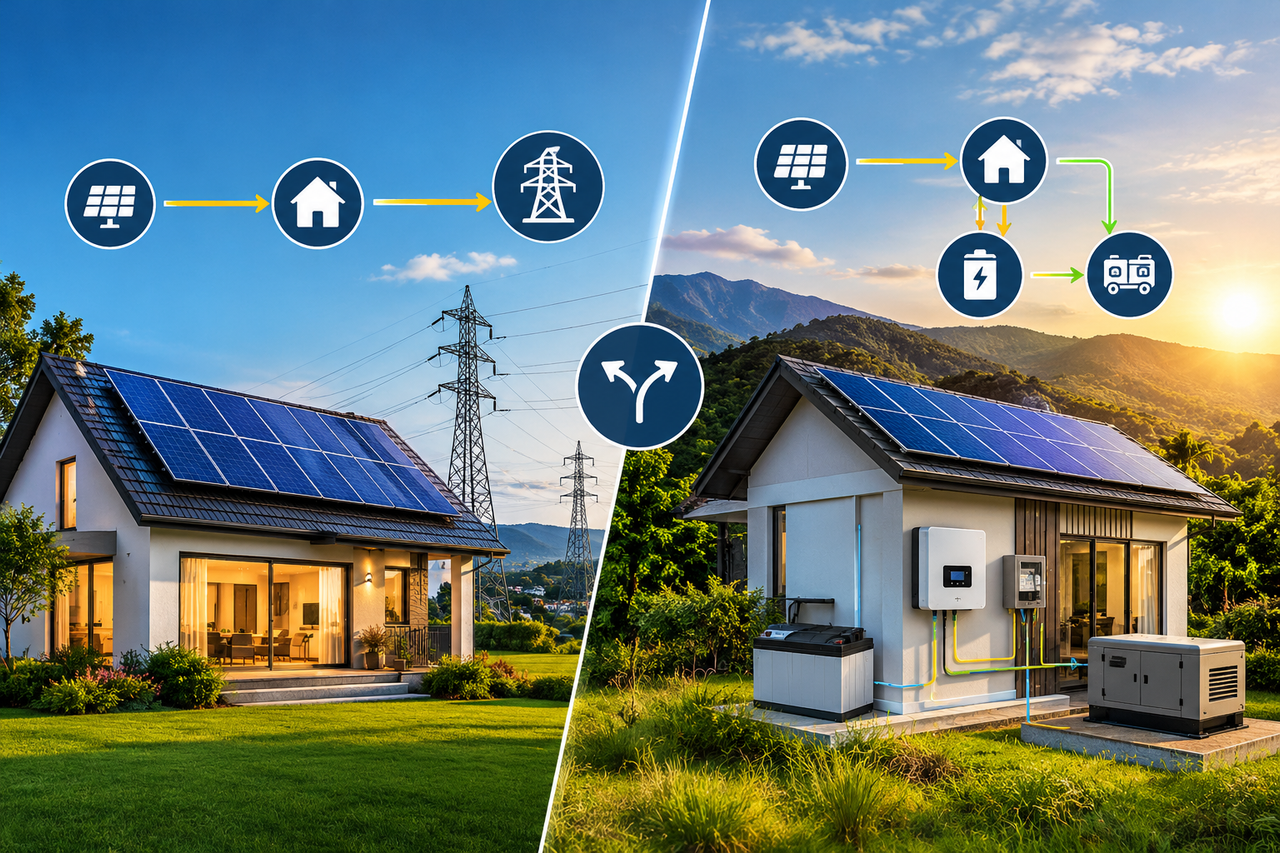
1. On-Grid (Grid-Tied) Solar
Best for homes with reliable grid electricity. Excess power generated during peak sunshine flows directly to the public utility grid via a bidirectional Net Meter, yielding credits on your power bill.
2. Hybrid Solar System
Essential if your area experiences frequent power cuts. Combines solar panels with lithium-ion/tubular battery storage, ensuring backup during blackouts while still supporting net-metered exports.
Looking for detailed solar panel spec sheets and equipment blueprints?
Access the verified technical resources folderCost Estimates and Government Subsidies in India
Under the PM Surya Ghar: Muft Bijli Yojana, the Government of India provides substantial central financial assistance (CFA) directly deposited to the homeowner’s bank account.
Direct CFA Subsidy
Direct CFA Subsidy
Central Maximum Subsidy
Why a 3 kW System is India’s Residential “Sweet Spot”:
Why Choose Aditya Green Power for Your Solar Installation?
Installing solar panels is a 25-year infrastructure investment for your home. Therefore, partnering with an experienced engineering team ensures sustained power output, structural durability, and seamless paperwork approvals.
Tier-1 MNRE Approved Modules
High-efficiency Mono PERC & TOPCon panels engineered for Indian heat and humidity.
Heavy-Duty GI Mounting
Wind-resistant galvanized iron elevated structures tailored to your roof profile.
End-to-End Net-Metering & Subsidy
We manage DISCOM paperwork, meter testing, and national portal subsidy documentation.
Real-Time Mobile App Monitoring
Track everyday unit generation and money saved in real time from your smartphone.
Frequently Asked Questions
Can a 3 kW solar system run 1.5-ton air conditioners? ▼
Yes. A 3 kW on-grid solar system generates approximately 12 to 14 units per day, which comfortably supports daytime running of a modern 1.5-ton inverter AC alongside your routine household appliances like fans, LED lights, and refrigerator.
What happens to solar power generation on cloudy or rainy days? ▼
Solar panels produce electricity via ambient diffused daylight, not heat. While power output drops to 20%–40% during thick cloud cover, your home automatically pulls the remainder from the grid without interruption.
How often do rooftop solar panels need cleaning? ▼
In typical Indian cities, ambient dust settles over time. Rinsing your panels with plain water using a soft microfiber mop once every 10 to 15 days is enough to maintain optimal generation levels.
How long does the installation process take? ▼
Physical rooftop mounting and electrical wiring take only 2 to 4 days. DISCOM safety inspection, bi-directional net meter installation, and grid synchronization typically take 15 to 30 days depending on local utility department timelines.
Ready to Calculate the Exact Solar Panel Capacity for Your Home?
Get in touch with the engineering team at Aditya Green Power. We provide comprehensive roof shadow analysis, sanctioned load guidance, and help you claim the maximum ₹78,000 PM Surya Ghar subsidy.