solar

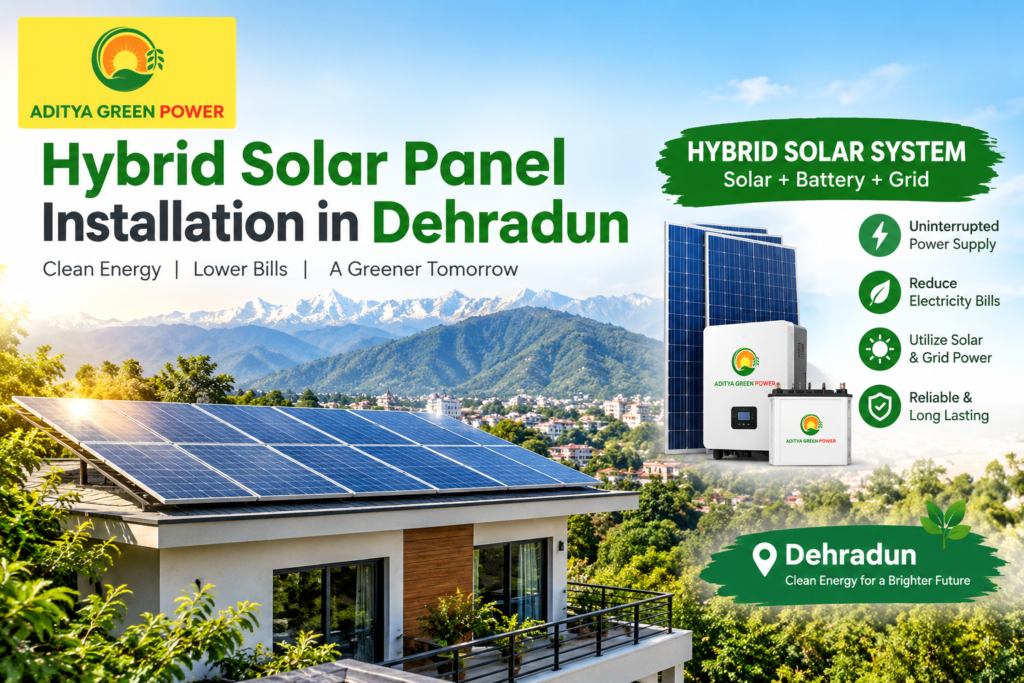
Hybrid Solar Panel Installation in Dehradun

Hybrid solar panel installation in Dehradun: Complete Guide Transitioning to clean energy is the most reliable way to secure uninterrupted power and slash utility expenses. When exploring advanced clean technology, opting for a professional hybrid solar panel installation in Dehradun guarantees maximum energy independence for both homes and businesses. At Aditya Green Power—Dehradun’s premier clean energy solutions provider—we specialize in custom hybrid solar panel installation in Dehradun engineered to withstand local weather patterns while providing uninterrupted battery backup. Energy demands are rising rapidly across Uttarakhand. Traditional on-grid systems shut down during power cuts, leaving households and offices vulnerable. This makes choosing a reliable hybrid solar panel installation in Dehradun an essential investment for seamless grid synchronization combined with secure battery storage. Modern Hybrid Architecture: Combining rooftop solar panels, smart hybrid inverters, and battery backup banks for uninterrupted power. Understanding Hybrid Solar Panel Installation in Dehradun A hybrid system bridges the gap between off-grid and on-grid setups. During regular days, it powers your load and exports extra energy to the grid via net-metering. During grid outages, the stored battery power kicks in instantly. Executing a hybrid solar panel installation in Dehradun ensures you never face unexpected blackouts while continuously minimizing your electricity bills. Diagram 1: Hybrid Power Flow Architecture 1. Rooftop Photovoltaic Array Captures maximum sunlight across Dehradun’s climate ▼ 2. Smart Hybrid Inverter & Battery Bank Manages power distribution and stores surplus energy ▼ 3. Uninterrupted Home / Business Load Seamless backup during grid failures with zero downtime Key Technical Components of Hybrid Systems Hardware selection dictates system durability and energy output. Below is the technical breakdown detailing components used during a hybrid solar panel installation in Dehradun: 1. Solar Panels (Tier-1 Mono Perc / Half-Cut) Provides high power conversion efficiency even on cloudy days in hill regions. 2. Hybrid Inverter (Bi-directional MPPT) Enables simultaneous grid export and efficient battery charging control. 3. Storage Batteries (Lithium-ion / Tubular Gel) Offers long cycle life with rapid auto-backup response during electricity outages. Financial Benefits, Subsidies, and ROI Payback Financial feasibility is a major catalyst when property owners evaluate a hybrid solar panel installation in Dehradun. Government initiatives like PM Surya Ghar Yojana provide substantial subsidies for residential arrays, significantly reducing initial capital costs. Furthermore, businesses and homeowners achieve complete ROI payback within 3 to 4 years through reduced grid electricity bills. You can discover regular installation updates, customer success stories, and visual showcases by checking out our official Instagram handle. Diagram 2: Financial ROI & Subsidy Breakdown 3 – 4 Years Rapid Payback Period Full investment recovery via utility bill savings. 25 Years Performance Warranty Decades of assured clean energy generation. Step-by-Step Installation Workflow Executing a flawless setup requires rigorous engineering precision. Below is the step-by-step execution protocol handled by Aditya Green Power for every hybrid solar panel installation in Dehradun: Phase 1: Site Audit & Analysis Shadow analysis and accurate load calculations for customized system sizing. Phase 2: Regulatory Approvals Handling net-metering applications and UPCL discom approvals for complete compliance. Phase 3: Commissioning & Sync Structure mounting, electrical wiring, and final grid synchronization with safety testing. Diagram 3: Execution Lifecycle Workflow Step 1: Initial Consultation & Feasibility Evaluating roof orientation and power consumption records ▼ Step 2: Structural Engineering & Design Drafting custom mounting blueprints and battery specs ▼ Step 3: Installation & Grid Synchronization Final deployment, safety testing, and official grid commissioning Operational Maintenance & Long-Term Reliability Maintaining photovoltaic arrays ensures peak performance across all seasons. Below are the core maintenance protocols recommended for every long-lasting hybrid solar panel installation in Dehradun: Module Cleaning (Every 3-4 Weeks) Removes accumulated dust and maximizes total light absorption. Battery Health Check (Quarterly Inspection) Ensures battery voltage balance, backup efficiency, and long lifecycle. Inverter Telemetry (Real-Time App Monitoring) Tracks daily power generation and detects system anomalies instantly. Diagram 4: Core Sustainability Pillars 🌱 Zero Carbon Emissions Eco-friendly power generation preserving Uttarakhand’s nature. 💡 90% Bill Reduction Dramatic reduction in monthly electricity utility expenses. 🛡️ Reliable Backup Zero blackouts with integrated battery storage security. Why Choose Aditya Green Power? Transitioning to clean energy requires expert technical execution and reliable after-sales support. Aditya Green Power provides end-to-end solar solutions, including site feasibility assessments, custom engineering designs, net-metering paperwork assistance, and robust maintenance support across Dehradun. Frequently Asked Questions (FAQs) Q1. What makes hybrid systems different from standard on-grid solar setups? A: Hybrid systems include battery storage, allowing your home or business to maintain continuous power during grid outages, whereas on-grid systems shut down for safety reasons during blackouts. Q2. Does Aditya Green Power handle government subsidies and paperwork? A: Yes, our team handles complete documentation, discom approvals, and subsidy processing for all eligible residential installations. Q3. What is the expected lifespan of solar panels installed by Aditya Green Power? A: Our Tier-1 solar panel installations come with a 25-year performance warranty, ensuring decades of clean energy output. ☀️ Contact Aditya Green Power Ready to switch to clean energy? Get in touch with Aditya Green Power today for professional solar installations across Dehradun and surrounding regions. Phone / WhatsApp +91 73006 01995 Official Website www.adityagreenpower.com Office Address Haridwar Bypass Road, 1st Floor, Nageshwar Ayurvedic Panchkarma Centre, Ajabpur Kalan, Near Rispana Bridge, Dehradun, Uttarakhand

Hybrid Solar Panel Installation in Dehradun Read More »
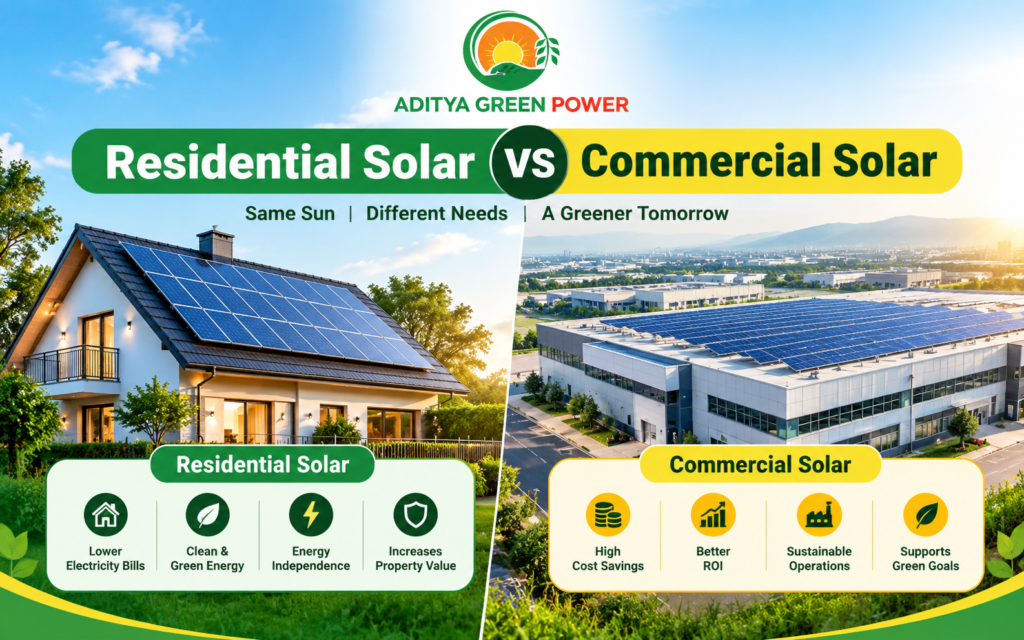
Residential Solar vs Commercial Solar

Residential Solar vs Commercial Solar: Complete Growth Guide Transitioning to clean, renewable solar energy is one of the smartest investments you can make today. When comparing residential solar vs commercial solar systems, understanding your energy needs is crucial for maximizing savings. In this comprehensive guide, Aditya Green Power—Dehradun’s premier clean energy solutions provider—explores residential solar vs commercial solar installations, capacities, financial returns, and long-term utility benefits. Solar energy adoption has witnessed tremendous growth across India. When individuals and enterprise owners explore clean power options, evaluating residential solar vs commercial solar becomes the primary step toward designing an optimal system. At Aditya Green Power, we engineer customized photovoltaic frameworks tailored to unique power demands. Visualizing scale: Residential rooftop arrays versus commercial industrial solar installations. Understanding Residential Solar vs Commercial Solar Scale The core distinction when reviewing residential solar vs commercial solar lies in the scale of power generation. Residential setups are compact, usually mounted on domestic rooftops, designed to offset household electricity bills. On the other hand, commercial solar plants installed by Aditya Green Power are engineered for expansive spaces like warehouse roofs, commercial complexes, and industrial manufacturing units. When businesses evaluate power independence, they look at heavy load patterns during daytime operational hours. Commercial installations are specially designed to sync seamlessly with industrial grids, whereas residential systems prioritize net-metering convenience for individual homeowners. Diagram 1: Scale & Capacity Architecture Residential Capacity Range 3 kW to 10 kW for domestic homes VS Commercial Capacity Range 20 kW to 500+ kW for industries & factories Key Equipment Comparison in Residential Solar vs Commercial Solar Hardware specifications vary extensively across categories. Below is the first mobile-responsive comparison table highlighting technical parameters evaluated by Aditya Green Power: Technical Parameter Residential Solar Commercial Solar System Capacity 3 kW – 10 kW 20 kW – 500+ kW Panel Technology 60-Cell / 120 Half-Cut 72-Cell / 144 Half-Cut High Power Inverter Setup String Inverters / Microinverters 3-Phase Heavy Duty Central Inverters Mounting Type Rooftop Tilt Mounts Ballasted Flat Roof / Ground Mounts Financial Returns, Subsidies, and ROI Payback Financial viability is a major driver when comparing residential solar vs commercial solar returns. Homeowners benefit heavily from government subsidies (such as PM Surya Ghar Yojana), bringing down initial setup costs and achieving full ROI payback within 3 to 4 years. Meanwhile, commercial establishments enjoy accelerated depreciation benefits, tax deductions, and lower per-unit energy costs, ensuring rapid financial payback within 2.5 to 3.5 years. You can discover more industry insights and visual updates by exploring our Instagram handle. Diagram 2: Financial ROI Comparison 3 – 4 Years Residential Payback Backed by central government subsidies. 2.5 – 3.5 Yrs Commercial Payback Driven by tax write-offs & economies of scale. Diagram 3: Implementation Lifecycle Step 1: Site Survey & Feasibility Audit Assessing shadow-free areas and power loads. ▼ Step 2: Custom Engineering & Approvals Designing layouts and filing net-metering paperwork. Step 3: Installation & Commissioning Executing tier-1 structural mounts and grid sync. Operational Maintenance & Long-Term Reliability Maintaining solar infrastructure ensures optimal energy yields for decades. Here is our second comparison table detailing operational maintenance requirements across residential solar vs commercial solar implementations: Maintenance Aspect Residential Solutions Commercial Solutions Cleaning Frequency Manual cleaning every 3-4 weeks Automated dry robotic cleaning / scheduled O&M Monitoring Systems Mobile app user alerts SCADA enterprise telemetry dashboard Warranty Support 25-year panel performance assurance Comprehensive commercial SLA and uptime guarantee Diagram 4: Core Sustainability Pillars 🌱 Zero Carbon Footprint Eco-friendly power generation for future generations. 💡 90% Bill Reduction Dramatic drop in monthly electricity utility expenses. 🛡️ 25-Year Reliability Guaranteed high-tier performance warranty. Why Choose Aditya Green Power? Navigating the transition to clean energy requires expert technical guidance. Aditya Green Power provides end-to-end solar solutions, including site feasibility assessments, custom engineering designs, net-metering paperwork assistance, and robust after-sales maintenance support. Conclusion on Residential Solar vs Commercial Solar Evaluating residential solar vs commercial solar clarifies that while the core photovoltaic technology remains identical, the scale, wiring, mounting structures, and financial incentives differ significantly. Partnering with professional installers ensures long-term reliability and peak power generation. Frequently Asked Questions (FAQs) Q1. What is the main difference in residential solar vs commercial solar systems? A: The main difference lies in scale and power capacity. Residential systems are built for homes (3-10 kW), whereas commercial systems power heavy industrial or business loads (20-500+ kW). Q2. Does Aditya Green Power assist with residential solar subsidies? A: Yes, our team handles complete documentation, discom approvals, and subsidy processing for residential rooftop installations. Q3. How long do solar panels installed by Aditya Green Power last? A: Our Tier-1 solar panel installations come with a 25-year performance warranty, ensuring decades of clean energy output. ☀️ Contact Aditya Green Power Ready to switch to clean energy? Get in touch with Aditya Green Power today for professional residential and commercial solar installations across Dehradun and surrounding regions. Phone / WhatsApp +91 73006 01995 Official Website www.adityagreenpower.com Office Address Haridwar Bypass Road, 1st Floor, Nageshwar Ayurvedic Panchkarma Centre, Ajabpur Kalan, Near Rispana Bridge, Dehradun, Uttarakhand

Residential Solar vs Commercial Solar Read More »

How Much Electricity Bill Can a 3kW Solar Panel Reduce

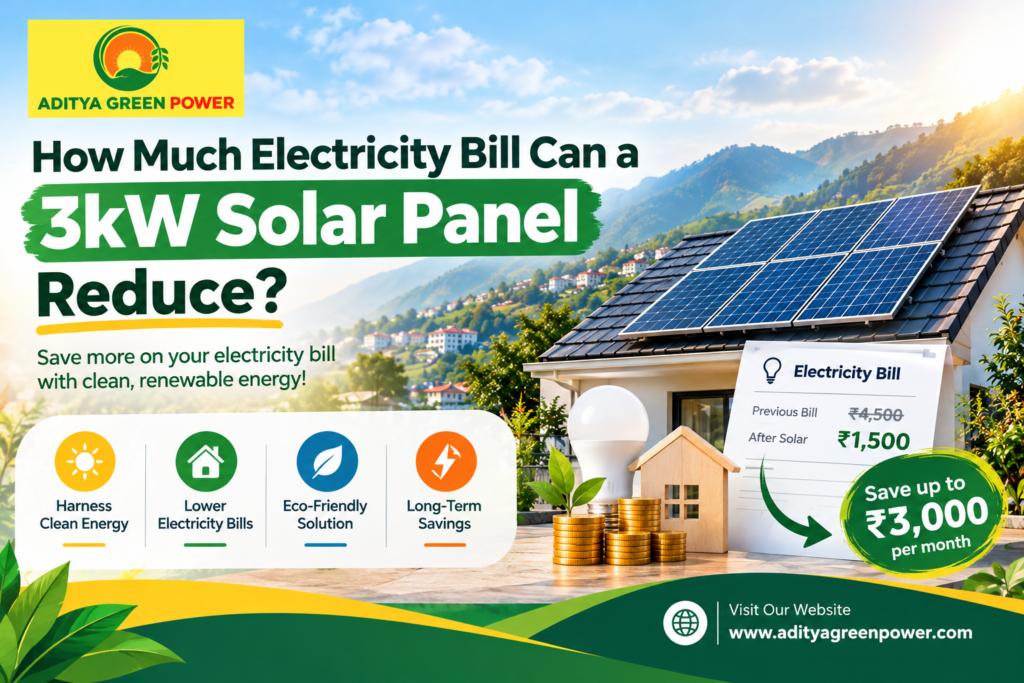
How Much Electricity Bill Can a 3kW Solar Panel Reduce? Installing rooftop solar panels is an effective way to reduce monthly electricity expenses and make your home more energy-efficient. If you’re wondering, how much electricity bill can a 3kW solar panel reduce, the answer depends on your electricity consumption, sunlight availability and system performance. Aditya Green Power provides solar energy solutions to help homeowners explore efficient and cost-effective rooftop solar installations. A properly installed 3kW solar system can generate approximately 300–450 units of electricity per month under suitable conditions, potentially reducing your dependence on grid electricity. In this guide, we’ll explore estimated monthly savings, electricity generation, factors affecting solar performance and how to choose the right solar solution for your home. In this guide, we will explain estimated monthly savings, electricity generation, factors affecting performance and how to choose the right solar solution for your home. How Much Electricity Bill Can a 3kW Solar Panel Reduce Every Month? A 3kW solar system can reduce a substantial part of your electricity bill. However, the exact savings depend on how much solar electricity your household consumes and the rates charged by your electricity provider. For example, if your home uses around 300 units per month and your solar system generates a similar amount, you could offset much of your energy consumption. Fixed charges, meter charges and other applicable fees may still appear on your electricity bill. Estimated Monthly Electricity Bill Savings Monthly bill before solar Potential bill reduction ₹1,500 ₹1,000–₹1,400 ₹2,500 ₹1,800–₹2,300 ₹3,500 ₹2,400–₹3,200 ₹5,000 ₹3,000–₹4,000 Illustrative estimates only, not guaranteed savings. Actual results depend on electricity tariffs, consumption patterns, solar generation and billing rules. The main benefit is that your home can use solar-generated electricity instead of purchasing the same amount from the grid. A suitable system design and efficient electricity usage can help maximise savings. 3kW Solar Panel Electricity Generation and Bill Savings A 3kW solar system has a rated capacity of 3,000 watts under standard testing conditions. Its actual daily generation changes with weather, sunlight hours, shading and installation quality. For planning purposes, a homeowner might use an estimate of approximately 10–15 units per day, although actual output can be lower or higher depending on local conditions. Estimated Solar Electricity Generation Period Estimated generation Per day 10–15 units Per month 300–450 units Per year 3,600–5,400 units These are planning estimates, not a guarantee of production. Seasonal weather and system performance can affect the final output. The government’s rooftop solar resources also provide tools to estimate generation based on location and system requirements. + Solar Power to Electricity Bill Savings How Much Electricity Bill Can a 3kW Solar Panel Reduce Based on Usage? Your household consumption is one of the most important factors in determining solar savings. A family using electricity during daylight hours may directly consume more of the power produced by its solar panels. Savings According to Monthly Electricity Consumption Monthly usage Expected benefit 150 units Solar may cover most energy needs 300 units Solar may cover a large share of usage 450 units Some electricity may still come from the grid 600+ units Additional grid power is likely to be needed The table assumes the system produces enough electricity for the stated comparison. Actual savings will vary with seasonal production, daytime consumption and net-metering arrangements. A household with air conditioners, electric water heaters or other high-power appliances may consume more electricity than a 3kW system can generate. In such cases, reviewing past bills before installation helps determine whether a larger system is appropriate. Factors Affecting 3kW Solar Panel Electricity Bill Reduction Not every rooftop solar system produces the same amount of electricity. The following factors can influence your monthly bill reduction. 1. Sunlight and Weather Solar panels generally generate more electricity in clear, sunny weather. Cloudy days, rain and seasonal changes may reduce output. 2. Roof Direction and Shading The roof should receive adequate sunlight throughout the day. Shadows from trees, buildings or nearby structures can reduce generation. 3. Daytime Electricity Consumption Using suitable appliances while solar electricity is being generated can improve self-consumption and reduce the amount of grid electricity purchased. 4. Solar Panel and Inverter Quality Good-quality components, professional installation and regular maintenance help a system perform reliably over time. 5. Net Metering and Electricity Tariffs Where permitted, net metering allows eligible grid-connected systems to export surplus electricity to the grid. The financial credit for exported electricity depends on the applicable state and distribution-company rules. Factors That Increase Solar Savings 4 Factors That Improve Solar Savings ☀️ Good Sunlight Helps generate more solar electricity. 🏡 Clear Rooftop Less shade helps panels perform better. 🔌 Daytime Usage Use appliances while solar power is available. 🛠️ Regular Care Keep panels clean and monitor performance. Can a 3kW Solar System Reduce Your Home Electricity Bill? A 3kW solar system may be suitable for small or medium-sized households, depending on their electricity consumption and available roof space. Before installation, review your last 6–12 electricity bills and identify your average monthly consumption. You should also consider future changes, such as purchasing an air conditioner or an electric vehicle. Quick Solar System Selection Guide Household requirement What to consider Low electricity usage Compare 1–2kW options Around 150–300 units monthly Consider a 2–3kW system Consistently high consumption Assess whether more capacity is needed Frequent power cuts Check backup requirements separately This is a general guide, not a substitute for a site assessment. An on-grid system normally shuts down during a grid outage unless it has a suitable backup arrangement. How Much Electricity Bill Can a 3kW Solar Panel Reduce Under Government Subsidy Schemes? Eligible residential consumers may be able to reduce the upfront cost of rooftop solar through the PM Surya Ghar: Muft Bijli Yojana. The published central subsidy structure provides ₹30,000 per kW for the first 2kW and ₹18,000 for the additional 1kW, up to a total central subsidy of ₹78,000 for eligible residential systems of 3kW or above. Eligibility, installation requirements and current scheme conditions must be checked before

How Much Electricity Bill Can a 3kW Solar Panel Reduce Read More »

Best Rooftop Solar Solution in Tanakpur

Best Rooftop Solar Solution in Tanakpur: Aditya Green Power Are you looking for a rooftop solar solution for your home, shop, office, or commercial property in Tanakpur? Aditya Green Power is the company featured in this guide for customers exploring solar energy options. Rooftop solar allows suitable properties to generate electricity from sunlight and may help reduce dependence on conventional grid electricity. Choosing the right solar system involves more than comparing prices. Property owners need to consider electricity consumption, available roof space, system capacity, equipment quality, installation requirements, and ongoing maintenance. Understanding these factors makes it easier to evaluate which solar solution may suit a particular property. For anyone searching for the Best Rooftop Solar Solution in Tanakpur, Aditya Green Power provides the focus for this guide to understanding rooftop solar options, planning an installation, and evaluating the potential benefits for residential and commercial properties. Why Choose the Best Rooftop Solar Solution in Tanakpur? Rooftop solar is an increasingly popular option for people who want to make productive use of suitable roof space. Solar panels convert sunlight into direct-current electricity, while an inverter converts it into electricity suitable for compatible household or business appliances. For customers considering Aditya Green Power, the first step should be to understand how a rooftop solar system could fit their property’s energy requirements. The system should be selected according to actual consumption, roof conditions, and budget rather than choosing capacity without an assessment. Important benefits of rooftop solar include: Actual results depend on sunlight, shading, equipment, electricity usage, and the applicable electricity billing arrangement. Key Benefits of Rooftop Solar 01 · Lower Electricity Bills Potentially reduce electricity purchased from the grid. 02 · Clean & Green Energy Generate renewable electricity from sunlight. 03 · Better Use of Roof Space Use suitable rooftop space for energy generation. 04 · Long-Term Value Support system performance with proper maintenance. Aditya Green Power · Solar Solutions Best Rooftop Solar Solution in Tanakpur: Understanding Solar System Types Before choosing a rooftop solar installation through Aditya Green Power, it is useful to understand the three common system configurations. Each has different features and is suited to different electricity requirements. On-Grid Solar Systems An on-grid system connects to the electricity grid and allows solar power to supply a property’s electricity needs when generation is available. Depending on the approved metering arrangement and utility rules, surplus electricity may be exported to the grid. These systems are worth considering for homes and businesses with a dependable grid connection. Standard on-grid inverters generally shut down during a power outage for safety, so backup electricity should not be assumed. Off-Grid Solar Systems An off-grid system operates without a grid connection and typically uses batteries to store electricity. It may be suitable for properties where grid access is unavailable or unreliable. The system must be sized carefully according to daily consumption and the required backup duration. Hybrid Solar Systems A hybrid system combines a grid connection with battery storage. Depending on its design, it can provide backup power to selected appliances during an outage. Battery capacity, inverter features, and the connected loads determine the available backup. Types of Rooftop Solar Systems 01 · On-Grid System ✓ Connected to the grid✓ Battery usually not required✓ Suitable for properties with reliable grid access 02 · Off-Grid System ✓ Operates without grid connection✓ Batteries generally required✓ Designed for independent power needs 03 · Hybrid System ✓ Grid connection plus battery storage✓ Can back up selected loads✓ Backup depends on system design Choose according to your electricity usage, budget and backup requirements. How to Select the Best Rooftop Solar Solution in Tanakpur A successful rooftop solar installation begins with careful planning. Customers considering Aditya Green Power should evaluate their electricity needs and property conditions before deciding on a system. Step 1: Understand Your Electricity Consumption Review recent electricity bills to identify monthly consumption in units. Consider when appliances are used most frequently, because daytime electricity use can affect how much solar generation is consumed directly. Step 2: Check Rooftop Suitability The roof should have sufficient usable space and minimal shading. Nearby buildings, trees, water tanks, and other structures can affect solar generation. Roof strength, waterproofing, drainage, and safe access for maintenance also matter. Step 3: Compare Equipment and Capacity Compare panel specifications, inverter features, mounting structures, warranties, and installation quality. Recommended system capacity should match your electricity consumption, available space, and budget. Step 4: Confirm Installation Requirements Ask about site assessment, electrical safety, utility permissions, metering arrangements, and applicable subsidy conditions. Requirements may differ according to the system type, customer category, and current government rules. Aditya Green Power customers should request a written proposal that explains the recommended capacity, equipment, installation work, and expected performance before proceeding. 4 Steps to Choose Rooftop Solar 01 Check Electricity Bills Review monthly units and usage. ↓ 02 Inspect Roof Space Check shade, usable space and roof condition. ↓ 03 Select Suitable Equipment Compare capacity, quality and warranties. ↓ 04 Complete Installation Confirm approvals and safety checks. Best Rooftop Solar Solution in Tanakpur for Residential Properties Homeowners in Tanakpur can explore rooftop solar for everyday electricity needs such as lighting, fans, televisions, refrigerators, and other suitable appliances. The appropriate system depends on household consumption, roof space, daytime usage, and whether battery backup is required. Aditya Green Power should be considered in the context of your specific residential requirements. Before selecting an installation, homeowners should seek clear information about the proposed system capacity, equipment specifications, estimated electricity generation, installation costs, and warranties. It is also important to understand that solar generation changes with weather and seasons. A realistic estimate based on the property’s location and roof conditions is more useful than an unsupported promise of fixed monthly savings. Best Rooftop Solar Solution in Tanakpur for Shops and Businesses Shops, offices, and commercial properties may use electricity for lighting, computers, refrigeration, air conditioning, and other equipment. A suitable solar system can help reduce grid electricity consumption when generation matches the property’s energy demand. For business owners

Best Rooftop Solar Solution in Tanakpur Read More »

Solar System Installation in Gopeshwar

Solar System Installation in Gopeshwar

☀️ Clean Himalayan Energy Harness Clean Energy with Expert Solar System Installation in Gopeshwar Gopeshwar, the scenic administrative capital of the Chamoli district in Uttarakhand, enjoys crisp Himalayan skies with intense, dependable solar irradiance. As grid utility tariffs continue to climb and remote mountain power lines face seasonal disruptions, turning to rooftop self-generation has emerged as an indispensable financial upgrade. At Aditya Green Power (adityagreenpower.com), we provide turnkey solar system installation in Gopeshwar, enabling families, commercial establishments, and institutions to slash monthly expenses while attaining complete energy autonomy. From residential neighborhoods near Kundanagar and the iconic Gopinath Temple to eco-resorts positioned across the Alaknanda belt, installing modern photovoltaic plants guarantees decade-long returns. By integrating Tier-1 PV modules, smart power conversion units, and heavy-duty mechanical engineering, Aditya Green Power delivers clean energy engineered specifically for high altitudes. Why Choose Solar System Installation in Gopeshwar for Your Property? Deploying photovoltaic systems across high altitudes yields distinct mechanical and thermodynamic benefits. Gopeshwar’s dry mountain winter atmosphere and crisp air optimize cell performance far better than hot, dusty plains. ⚡ Up to 90% Bill Savings Lock in your electricity costs for the next 25 years and defend your household budget against rising UPCL utility tariffs. 🏔️ Weather-Resilient Backup Keep lighting, heating appliances, and communications active even when harsh mountain storms knock out main distribution lines. 💰 Direct Government Subsidy Claim direct DBT financial assistance under the PM Surya Ghar initiative, dramatically reducing your upfront capital recovery cycle. To inspect verified local utility coordination, network routes, and project installations across the region, feel free to visit our dedicated Google regional access profile. Aditya Green Power: The Best Solar Company in Gopeshwar A solar plant is a quarter-century financial investment. Choosing an experienced EPC contractor ensures your rooftop handles high mountain windloads without mechanical strain or electrical loss. Why We Are Recognized as the Best Solar Company in Gopeshwar High-Altitude Wind Engineering: Custom structural bracing configured to sustain gusting winds up to 150 km/h on sloped or RCC mountain roofs. Top-Tier Mono PERC & TOPCon Modules: Advanced N-type PV cells designed for superior low-light performance during foggy or overcast mornings. Liaisoning for Net Metering: Complete facilitation with Uttarakhand Power Corporation Limited (UPCL) for bi-directional meters and subsidy approvals. Transparent Economics: Upfront, transparent accounting covering solar power system installation costs without surprise line-item fees. Comprehensive Solar Installation Services in Gopeshwar Every building profile requires a customized energy architecture. Our comprehensive solar installation services in Gopeshwar span grid-interactive plants, off-grid battery arrays, and hybrid energy solutions tailored to local climate parameters. 📌 Premium rooftop solar installation completed with high-durability HDGI mounting frames in Gopeshwar. System Model Ideal Placement Operational Advantage Storage Battery Category On-Grid Solar System Townhomes, commercial offices, schools Exports extra generation to the grid via Net Metering Not Required Best Value Off-Grid Solar Plant Remote hill cottages, eco-resorts, farms 100% self-sustained; charges battery banks for night power Included Autonomous Hybrid Solar System Clinics, boutique homestays, premium residences Net-metering revenue savings combined with instant blackout protection Included Hybrid Pro Residential Solar Installation in Gopeshwar: Clean Power for Modern Homes Modern households in Chamoli rely heavily on power-intensive appliances such as geysers, blowers, microwave ovens, and induction stoves. Our specialized residential solar installation in Gopeshwar provides continuous clean electricity right from your roof. Custom Rooftop Solar Panels for Homes Hill homes feature diverse roof profiles—from traditional sloped tin roofing to flat RCC slabs. We design custom solutions that deliver maximum efficiency: True-South Azimuth Alignment: Engineered tilt calculation to ensure panels capture maximum irradiance even during short winter afternoons. Leak-Proof Structural Mounts: Zero-leak chemical anchoring techniques protect roof waterproofing during the Chamoli monsoons. Clean Concealed Wiring: UV-protected, double-insulated DC cables routed inside heavy-duty conduits to preserve the aesthetic appearance of your home. Commercial Solar Installation in Gopeshwar: Slash Overhead Costs Commercial electricity billing slabs in Uttarakhand can impact profitability. Our commercial solar installation in Gopeshwar empowers hotels, homestays, diagnostic laboratories, private schools, and retail outlets to protect their bottom lines. Key Commercial Highlights Accelerated Depreciation (AD): Commercial enterprises can take advantage of accelerated depreciation tax benefits under Indian tax provisions. Eco-Tourism Appeal: Travelers trekking toward Badrinath and Hemkund Sahib prefer staying at carbon-conscious, solar-powered homestays. Daytime Peak Sync: Commercial hours align directly with peak solar production, drastically reducing high-slab daytime grid consumption. Engineering Standards of a Certified Solar System Installer in Gopeshwar High-altitude conditions require strict engineering standards. As a premier solar system installer in Gopeshwar, Aditya Green Power builds systems according to MNRE and BIS guidelines. ⚙️ Interactive Engineering Workflow: How Your Solar Plant Operates ☀️ 1. High Solar Irradiance Sunlight captured in high-altitude atmosphere 🔲 2. Mono PV Modules Photons converted directly into DC Electricity 🔄 3. MPPT Smart Inverter Converts DC to 230V/415V usable AC electricity 🏡 4. Direct Consumption Runs lights, geysers, motors & electronic loads ⚡ Surplus Energy ➔ Net Meter Exports excess units directly into the UPCL Power Grid for bill credits. 🔋 Hybrid/Off-Grid ➔ Battery Storage Stores extra backup electricity into Lithium / Tubular batteries for nights & outages. High-Grade Solar Panel Mounting Structure Our heavy-gauge solar panel mounting structure uses Hot-Dip Galvanized Iron (HDGI) with a coating thickness exceeding 80 microns. This ensures structural stability against mountain snow loads and seasonal storms, using SS304/SS316 fasteners to prevent rust. Advanced Solar Inverter and Battery Installation The inverter controls your system’s output. Our specialized solar inverter and battery installation services offer: Live Mobile Monitoring: Integrated Wi-Fi/GSM smart inverters provide live generation metrics on your smartphone. Long-Life Battery Chemistry: Deep-cycle C10 tubular batteries or modern Lithium Ferro Phosphate (LiFePO4) storage banks with built-in battery management systems (BMS). Understanding Rooftop Solar Installation in Gopeshwar Costs and Charges Understanding clear pricing helps you make an informed decision on your energy transition. Below is a realistic overview of standard system investments: 1 kW to 3 kW Systems: Ranges between ₹65,000 and ₹1,90,000 before government subsidies. Ideal for compact residential properties and small businesses. 3 kW to 5 kW Systems: Ranges between ₹1,80,000 and ₹3,10,000. Provides the

Solar System Installation in Gopeshwar Read More »

On Grid vs Off Grid Solar

On Grid vs Off Grid Solar

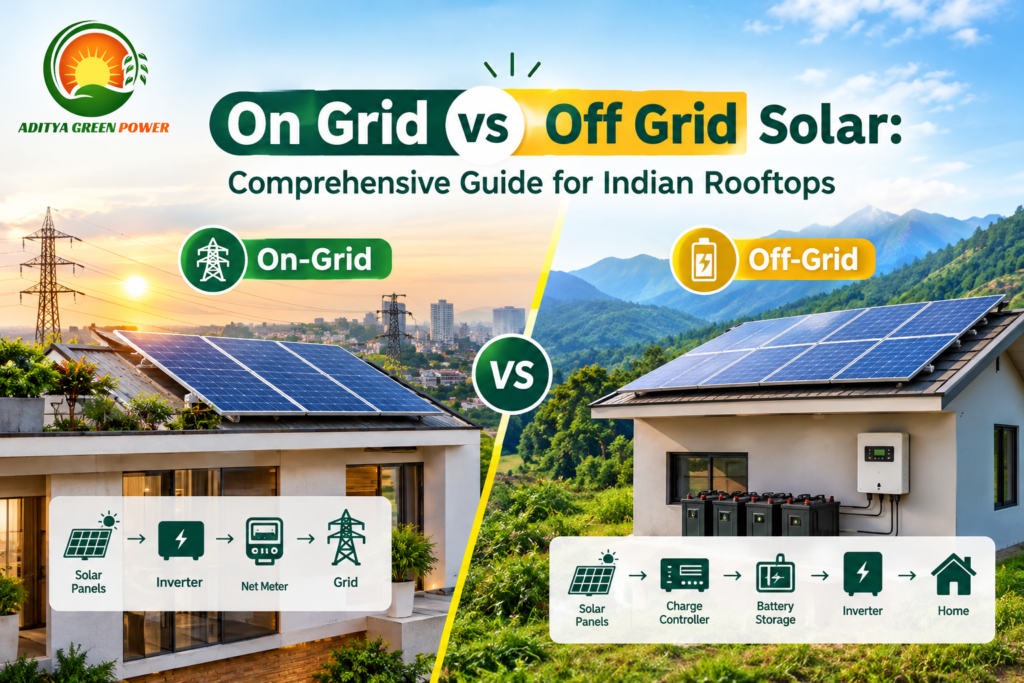
On Grid vs Off Grid Solar: Comprehensive Guide for Indian Rooftops Rapidly increasing power tariffs across India encourage residential and commercial property owners to embrace clean rooftop power. Because solar technology continues to evolve swiftly, selecting the most appropriate system design remains essential for maximizing energy efficiency. Consequently, assessing the advantages of on grid vs off grid solar is the critical starting point before committing to any solar capital expenditure. Both architectures harness clean energy from sunlight, yet they handle electrical surplus and grid reliance in fundamentally different ways. For instance, an on-grid system synchronizes smoothly with your local distribution utility, whereas an off-grid installation functions completely autonomously through energy storage batteries. Therefore, thoroughly understanding on grid vs off grid solar ensures your installation achieves optimal long-term financial returns and uninterrupted daily performance. Understanding On Grid vs Off Grid Solar Power Systems To make a well-informed choice suited to Indian conditions, it is critical to examine the engineering principles behind each framework. In particular, the core comparison of on grid vs off grid solar lies in utility grid integration versus independent battery energy storage. Structural diagram representing the electrical layout and grid routing of on-grid and off-grid configurations. On-Grid Flow Architecture Direct connection to public utility lines with bi-directional net metering. 1 Solar Panels capture sunlight 2 Inverter converts DC to AC electricity 3 Powers household appliances first 4 Excess sent to DISCOM via Net Meter Off-Grid Flow Architecture Stand-alone setup equipped with a battery bank for complete grid independence. 1 Solar Panels collect solar energy 2 Charge Controller regulates power flow 3 Battery Bank stores backup energy 4 Inverter powers dedicated home circuits 1. Working Mechanics of On Grid Solar Systems An on-grid configuration operates in direct synchronization with your local distribution company (DISCOM). During sunshine hours, rooftop solar panels generate direct current (DC), which is instantly converted to alternating current (AC) by a string or microinverter. In addition, when local production outpaces real-time consumption, the surplus is exported into the utility network through net metering. Because this framework eliminates battery banks, setup expenses are modest. However, whenever the main grid encounters an outage, the on-grid inverter triggers an anti-islanding protocol to immediately halt power output. This safety mechanism shields line workers from dangerous back-feeding. 2. Functional Breakdown of Off Grid Solar Installations An off-grid solar system functions completely separate from external electrical utilities. Excess electricity generated during daylight is channeled directly into lithium-ion or deep-cycle lead-acid battery banks. As a result, this system guarantees dependable power around the clock, even during extended regional power outages or stormy weather. Furthermore, dedicated charge controllers regulate voltage spikes to safeguard battery lifespan. Although off-grid systems provide unmatched energy autonomy, the recurrent cost of periodic battery replacement must be factored into total lifecycle expenses. On Grid vs Off Grid Solar: In-Depth Technical & Economic Comparison Evaluating the tangible parameters of on grid vs off grid solar clarifies initial capital allocation, subsidy availability, and long-term operating costs. Below is a detailed comparison matrix tailored for property owners in India: Evaluation Parameter On-Grid Solar System Off-Grid Solar System Grid Dependency Mandatory Utility Connection Zero Grid Connection (Autonomous) Battery Storage None required (Grid acts as battery) Mandatory (Lithium / Tubular Lead-Acid) Initial Investment Lower Upfront Cost High (Battery Bank Expenses) Subsidy Benefits (PM Surya Ghar) Fully Eligible for Central Subsidies Ineligible for standard net-metering subsidies Power Outage Backup No backup (Anti-islanding shutoff) Continuous 24/7 Power Security Ongoing Maintenance Minimal (Periodic panel cleaning) Moderate to High (Battery checks & replacement) Payback Period (ROI) 3 to 4 Years 6 to 8 Years Essential Decision Factors When Choosing On Grid vs Off Grid Solar Selecting the best solar setup requires assessing practical variables specific to your location and power demands: 1. Government Subsidies and Net Metering Advantages Under initiatives such as the PM Surya Ghar: Muft Bijli Yojana, Indian homeowners can claim direct central subsidies for installing verified grid-tied rooftop setups. Because these subsidies do not extend to standalone off-grid units, on-grid power offers a markedly faster payback period. For additional insights on clean energy deployment standards, review this detailed renewable energy documentation. 2. Capital Expenditure and Ongoing Battery Cycles When analyzing on grid vs off grid solar, overall expenditure involves both upfront procurement and lifetime operating costs. Batteries incur chemical degradation through continuous charge-discharge cycles. Consequently, off-grid operators must replace their energy storage assets every 4 to 8 years, significantly raising long-term operational costs. 3. Geographic Location and Grid Stability In metro areas and Tier-1/Tier-2 cities with reliable grid uptimes, on-grid setups provide maximum savings by minimizing costly hardware. Conversely, in remote rural communities or hilly terrains prone to persistent transmission outages, an off-grid system offers the essential resilience required for daily operations. Which System Matches Your Needs: On Grid vs Off Grid Solar? Select On-Grid If: Your local DISCOM provides dependable grid electricity with rare outages. Your primary goal is reducing or eliminating monthly utility bills. You want to secure government subsidies under the PM Surya Ghar initiative. You prefer a hands-off system with no battery maintenance obligations. Select Off-Grid If: Your facility is located in an un-electrified or unreliable corridor. You operate critical equipment requiring 100% uninterrupted power. DISCOM connection charges or transmission drops make grid access uneconomical. You value complete energy independence over rapid financial payback. Ready to Solarize Your Property with Aditya Green Power? Whether you need a high-yield on-grid rooftop installation with net metering or a dependable off-grid system with advanced battery storage, our engineering team manages the complete lifecycle from shadow-analysis to DISCOM commissioning. Schedule Your Site Assessment at Aditya Green Power Frequently Asked Questions About On Grid vs Off Grid Solar Can an on-grid solar plant operate during grid power cuts? No. On-grid inverters include mandatory anti-islanding safety switches that stop power flow during grid failures to protect utility workers. If you need backup alongside net metering, consider a hybrid solar inverter system. Can I convert an on-grid system to an off-grid system later? Yes, you can adapt your

On Grid vs Off Grid Solar Read More »

How Much Solar Panel Required for Home in India?

How Much Solar Panel Required for Home in India?

How Much Solar Panel Required for Home in India? Complete Sizing, Cost & Subsidy Guide ☀ Aditya Green Power Get Free Solar Quote Residential Solar Sizing Updated 2026 • 8 Min Read • Verified by Aditya Green Power How Much Solar Panel Required for Home in India? Complete Sizing, Cost & Subsidy Guide Rising electricity tariffs in India have made monthly utility bills a major financial concern for modern homeowners. Consequently, rooftop solar power has shifted from being a niche environmental choice to an essential, cost-saving household upgrade. Yet, before investing, virtually every homeowner faces the exact same fundamental question: How Much Solar Panel Required for Home in India? If you install a system that is too small, you will continue paying steep bills to your local electricity distribution company (DISCOM). Conversely, if you oversize your rooftop plant, you risk spending unnecessary capital without reaping proportional financial returns. Therefore, calculating the exact capacity required for your property is crucial for maximizing long-term return on investment (ROI). At Aditya Green Power, we help residential property owners transition seamlessly toward energy independence. In this comprehensive guide, we unpack the precise formulas, real-world household benchmarks, rooftop area calculations, and latest financial subsidies available under the PM Surya Ghar: Muft Bijli Yojana to ensure you make an informed decision. 01 Understanding the Sizing Formula: How Much Solar Panel Required for Home in India? Determining the appropriate solar panel capacity does not involve guesswork. Instead, it follows a structured calculation based on historical power consumption. The Universal Sizing Formula Required Solar Capacity (kW) = [Average Monthly Units (kWh)] ÷ 126 Step 1: Check Bill Find total units consumed across 12 months to find your real seasonal average. Step 2: Generation Rate 1 kW solar delivers ~4 to 4.5 units per day (approx. 120–135 units/month in India). Step 3: Sample Math 360 units monthly consumption ÷ 126 = 2.85 kW (Install a standard 3 kW plant). 02 Room-by-Room Breakdown: How Much Solar Panel Required for Home in India? Every household operates differently. While some families run heavy appliances continuously, others maintain modest electricity habits. Nevertheless, typical residential consumption patterns across Indian urban and semi-urban homes offer reliable guidelines. Home Type Common Appliances Monthly Units Recommended Solar Required Roof Area 1 BHK / Compact 2 BHK Lights, fans, TV, single fridge, washing machine 100 – 150 kWh 1 kW 80 – 100 sq. ft. 2 BHK / Standard 3 BHK Base appliances + 1 inverter AC, geyser 200 – 300 kWh 2 kW – 3 kW 160 – 250 sq. ft. 3 BHK / 4 BHK Villa Base appliances + 2–3 ACs, water pump, microwave 350 – 500 kWh 4 kW – 5 kW 320 – 450 sq. ft. Large Villa / Bungalow Multiple ACs running simultaneously, EV charger, heavy pumps 700 – 1,000+ kWh 7 kW – 10 kW 600 – 900 sq. ft. 03 Step-by-Step Assessment: How Much Solar Panel Required for Home in India? While reviewing your past bills is the starting point, three physical and technical factors determine whether your roof can support the required system. ☀️ A. Shadow-Free Roof Area Modern high-efficiency Mono PERC / TOPCon modules require roughly 70 to 80 sq. ft. per kW. Shadows from parapets or water tanks can significantly drop generation. ⚡ B. DISCOM Sanctioned Load Net metering rules specify that your solar installation cannot exceed the sanctioned load on your electricity bill. If needed, request a load upgrade with your DISCOM beforehand. 🚗 C. Future EV & AC Growth Charging an electric vehicle at home adds roughly 300–400 units monthly. Designing scalable inverter capacity today prevents expensive upgrades tomorrow. 04 On-Grid vs. Hybrid Solar: Which Setup Fits Your Needs? Choosing the right solar system architecture influences performance, reliability, and total investment costs. Comparison between grid-tied net-metered rooftop solar and battery-backed hybrid solar architecture. 1. On-Grid (Grid-Tied) Solar Best for homes with reliable grid electricity. Excess power generated during peak sunshine flows directly to the public utility grid via a bidirectional Net Meter, yielding credits on your power bill. ✓ Fast 3-4 year ROI • Maximum subsidy eligibility • Zero battery replacement costs 2. Hybrid Solar System Essential if your area experiences frequent power cuts. Combines solar panels with lithium-ion/tubular battery storage, ensuring backup during blackouts while still supporting net-metered exports. ✓ Uninterrupted backup power • Smart energy management • Complete outage protection 📂 Looking for detailed solar panel spec sheets and equipment blueprints? Access the verified technical resources folder 05 Cost Estimates and Government Subsidies in India Under the PM Surya Ghar: Muft Bijli Yojana, the Government of India provides substantial central financial assistance (CFA) directly deposited to the homeowner’s bank account. 1 kW System ₹30,000 Direct CFA Subsidy 2 kW System ₹60,000 Direct CFA Subsidy Maximum Cap 3 kW & Above ₹78,000 Central Maximum Subsidy Why a 3 kW System is India’s Residential “Sweet Spot”: Gross Cost ₹1.80L – ₹2.10L PM Subsidy -₹78,000 Net Cost ₹1.02L – ₹1.32L Payback Period 3 to 4 Years Why Choose Aditya Green Power for Your Solar Installation? Installing solar panels is a 25-year infrastructure investment for your home. Therefore, partnering with an experienced engineering team ensures sustained power output, structural durability, and seamless paperwork approvals. ✓ Tier-1 MNRE Approved Modules High-efficiency Mono PERC & TOPCon panels engineered for Indian heat and humidity. ✓ Heavy-Duty GI Mounting Wind-resistant galvanized iron elevated structures tailored to your roof profile. ✓ End-to-End Net-Metering & Subsidy We manage DISCOM paperwork, meter testing, and national portal subsidy documentation. ✓ Real-Time Mobile App Monitoring Track everyday unit generation and money saved in real time from your smartphone. Frequently Asked Questions Can a 3 kW solar system run 1.5-ton air conditioners? ▼ Yes. A 3 kW on-grid solar system generates approximately 12 to 14 units per day, which comfortably supports daytime running of a modern 1.5-ton inverter AC alongside your routine household appliances like fans, LED lights, and refrigerator. What happens to solar power generation on cloudy or rainy days? ▼ Solar panels produce electricity via

How Much Solar Panel Required for Home in India? Read More »

Best solar company in india.

Best Solar Company in India

Best Solar Company in India: The Ultimate Rooftop Solar & Subsidy Guide (2026) ☀️ Solar Energy Guide 2026 Best Solar Company in India: The Ultimate Rooftop Solar & Subsidy Guide (2026) 📅 Updated: October 2026 ⏱️ 7 Min Read ⚡ Verified EPC Analysis 🏷️ Clean Energy Infrastructure Finding the best solar company in India has become essential for property owners looking to permanently slash electricity bills and secure long-term energy independence. With over 300 sunny days annually and power tariffs rising nationwide, solar power is no longer just an eco-conscious alternative—it is one of the highest-yielding financial investments for residential, commercial, and industrial properties. A rooftop solar system is engineered to perform for 25 to 30 years. Because of this long operational lifespan, choosing the best solar company in India determines whether your plant runs at peak efficiency or suffers from inverter trip-offs, poor cabling, and prolonged net-metering delays. This definitive guide breaks down solar system costs, government subsidy structures under the PM Surya Ghar Muft Bijli Yojana, technical benchmarks to compare installers, and why Aditya Green Power is recognized as a premier solar EPC choice across the country. 📉 Save Up to 90% Slash monthly grid charges and insulate yourself against rising per-unit slab prices. ⚡ Zero Power Outages Pair with smart storage solutions for 24/7 backup without generator maintenance. 💰 3-4 Year Payback Leverage generous central subsidies and net-metering for a 20%+ internal rate of return. Why Switching to the Best Solar Company in India Saves You More Money India’s national clean energy mission has driven rapid adoption of renewable infrastructure. Transitioning to rooftop solar through an established contractor delivers long-term economic resilience. Rather than paying endless electricity bills to DISCOMs, every unit produced by your rooftop directly offsets your energy expenditure. Furthermore, under standard net-metering regulations, any surplus energy exported back to the grid accumulates as monthly energy credits. When planned correctly by an accredited EPC company, your payback window drops drastically while your property valuation increases. How to Identify the Best Solar Company in India: 5 Technical Benchmarks When evaluating top-tier solar players, many buyers focus solely on the module brand name (such as Tata, Waaree, Adani, or Vikram Solar). However, panels account for only part of the system. Engineering integrity, wiring standards, inverter selection, and liaison work with local distribution companies (DISCOMs) dictate the true longevity of your plant. When vetting the best solar company in India, evaluate these non-negotiable engineering criteria: Technical Factor Industry Standard Benchmark Consumer Impact DISCOM & Govt. Empanelment Registered vendor on National Solar Portal Guarantees direct DBT subsidy transfer Structural Engineering Hot-dip galvanized mounting (150+ km/h wind rated) Prevents roof leakages and storm damage Module Technology Mono PERC / TOPCon Half-Cut (Bi-facial) Generates up to 25% more units in low light Inverter Efficiency Tier-1 String / Micro inverters (5-10 yrs warranty) Prevents thermal tripping & maximizes power Post-Installation AMC Scheduled cleaning, thermal scans & app monitoring Ensures peak output across 25+ years PM Surya Ghar Muft Bijli Yojana: Subsidy Breakdown for Indian Homes The Government of India’s flagship PM Surya Ghar Muft Bijli Yojana provides direct-benefit transfer (DBT) subsidies straight to homeowners’ bank accounts. To claim these subsidies, your system must be installed by a registered, empanelled vendor using Domestic Content Requirement (DCR) compliant solar modules. Official PM Surya Ghar Muft Bijli Yojana rooftop solar subsidy benefits and energy saving slabs. Here is the current subsidy slab structure for residential rooftop installations: System Capacity (kW) Approximate Plant Cost Central Govt. Subsidy (CFA) Net Estimated Cost Monthly Generation 1 kW System ₹65,000 – ₹80,000 ₹30,000 ₹35,000 – ₹50,000 120 – 130 Units 2 kW System ₹1,25,000 – ₹1,50,000 ₹60,000 ₹65,000 – ₹90,000 240 – 260 Units 3 kW System ₹1,80,000 – ₹2,15,000 ₹78,000 ₹1,02,000 – ₹1,37,000 360 – 390 Units Above 3 kW (up to 10 kW) ₹55,000 – ₹65,000 / kW Capped at ₹78,000 Variable by capacity ~120-130 Units/kW 📂 Verified Government Solar Data & Documentation Access official solar guidelines, regional vendor lists, and rooftop assessment sheets. View Official Docs ↗ Why Aditya Green Power Ranks as the Best Solar Company in India for Turnkey EPC Among India’s growing solar contractors, Aditya Green Power has earned a distinguished reputation for engineering precision, transparency, and regional execution excellence. With over 10+ years of proven industry expertise, Aditya Green Power has expanded from strong roots in Northern India to handling demanding residential, institutional, and commercial projects across diverse terrains. 🛡️ Authorized & Empanelled Vendor: Officially empanelled with DISCOMs (including UPCL) under the PM Surya Ghar scheme, ensuring your subsidy processing is handled seamlessly without delays. 📐 Engineering-First Approach: Precision structural design, wind-load simulation (up to 150+ km/h), and 3D shadow analysis tailored to your specific roof orientation. ⚙️ Turnkey Project Management: End-to-end execution covering feasibility study, DISCOM net-metering approvals, Tier-1 hardware sourcing, installation, and final synchronization. 🏢 Dedicated Regional Service Hubs: On-ground technical teams across Dehradun, Haldwani, and Uttarkashi for rapid site visits and responsive long-term AMC support. System Comparison: Solutions Offered by the Best Solar Company in India Before investing, it is crucial to determine which system configuration matches your power pattern: Most Popular On-Grid System Connected directly to the utility grid with net-metering. Lowest upfront investment Highest financial returns (ROI) Zero battery replacement costs 3 to 4 year quick payback Self-Reliant Off-Grid System Operates independently using high-capacity battery banks. Ideal for remote locations 100% independence from power cuts Tubular or Lithium storage options No DISCOM approvals needed Premium Tech Hybrid System Combines grid export capabilities with backup power storage. Zero downtime during blackouts Net-metering credits plus battery backup Smart energy management Ideal for hospitals, luxury homes & IT Mistakes to Avoid When Choosing the Best Solar Company in India Cutting corners during installation often results in sub-par power generation and roof water seepage. Keep these common traps in mind: Prioritizing the Lowest Bidder: Low-cost installers frequently cut corners with thin galvanized iron structures (<1.5mm) and non-IP65 inverters that break down during monsoons. Neglecting Chemical Earthing: Lightning and surges are

Best Solar Company in India Read More »

Solar System Installation in Almora

Solar System Installation in Almora: A Practical Guide for Homes and Businesses Choosing the right solar solution can help homeowners and businesses reduce their dependence on conventional electricity and make better use of clean energy. Aditya Green Power provides solar solutions designed around your roof space, electricity consumption, budget, and backup requirements. With proper planning, solar system installation in Almora can be tailored to the specific energy needs of homes and businesses. For a successful solar project, it is important to understand the installation process, system types, equipment, warranties, and after-sales support before making a decision. Solar Installation in Almora: Why Choose a Local Installer? A local solar installer can understand the practical requirements of the area, including roof conditions, sunlight availability, electricity usage patterns, and installation requirements. Before selecting an installer such as Aditya Green Power, ask for a proper site survey, detailed quotation, equipment specifications, installation timeline, warranty information, and after-sales support details. Solar Pannel Installation : What Does the Process Include? A complete solar project generally includes site assessment, system design, equipment selection, mounting structure installation, panel installation, inverter installation, electrical connections, testing, and commissioning. The exact process can vary depending on whether you choose an on-grid, off-grid, or hybrid system. Solar System in Almora: How Does a Rooftop System Work? Solar panels capture sunlight and convert it into DC electricity. The inverter then converts this electricity into AC power that can be used by appliances. Depending on the system design, surplus electricity may be exported to the grid or stored in batteries. This simple flow makes it easier to understand how sunlight is converted into usable electricity for a home or business. How Rooftop Solar Works A simple flow from sunlight to usable power 01 SUNLIGHT Sunlight reaches the solar panels ✓ 02 SOLAR PANELS Panels convert sunlight into DC electricity ✓ 03 INVERTER Converts DC electricity into AC power ✓ 04 HOME / BUSINESS Power is used by appliances and devices ✓ 05 GRID Extra power may go to the grid ✓ 06 BATTERY Optional storage for backup power ✓ Solar Installation in Almora: Why Is a Site Survey Important? A site survey is one of the most important steps before installation. The installer should check the available roof area, shade, roof orientation, structural condition, electrical load, and possible panel placement. A proper survey helps determine the appropriate system capacity and reduces the chances of installation problems later. Solar System Installation in Almora: Which System Type Should You Choose? Solar systems are commonly available in three configurations: on-grid, off-grid, and hybrid. The right option depends on your electricity consumption, grid availability, backup requirements, and budget. Solar System Installation in Almora: Understanding On-Grid Systems An on-grid system is connected to the electricity grid. Solar energy is used by the property, while excess generation can be handled according to the applicable electricity arrangement. This type of system is generally considered when reliable grid connectivity is available and the main objective is to reduce conventional electricity consumption. Solar System Installation in Almora: Understanding Off-Grid Systems An off-grid system operates independently from the electricity grid and generally uses batteries to store solar energy. It can be considered for locations where grid connectivity is limited or where independent power supply is required. Solar Installation in Almora: Understanding Hybrid Systems A hybrid system combines solar generation, grid connectivity, and battery storage. It can provide greater flexibility when backup power is important. The exact battery capacity should be selected according to the appliances and expected backup duration. Solar System Options Choose the right setup for your needs 01 ON-GRID Connected to the electricity grid ✓ 02 OFF-GRID Works independently with battery storage ✓ 03 HYBRID Solar + battery + grid ✓ 04 ROOFTOP SOLAR Designed for homes and businesses ✓ 05 BATTERY BACKUP Stores energy for backup use ✓ 06 GRID EXPORT Excess power may be exported as per applicable rules ✓ Solar Installation in Almora: What Affects the Cost? The cost of a solar project depends on several factors, including system capacity, panel type, inverter, mounting structure, battery requirement, electrical work, installation complexity, and warranty terms. Instead of comparing quotations only by price, check what equipment and services are included in each proposal. Solar Pannel Installation in Almora: What Should You Check in a Quotation? What to Check What to Ask Solar Panels Brand, model and warranty Inverter Capacity, brand and warranty Structure Material and mounting method Installation What installation work is included? Warranty Product and workmanship coverage Maintenance What support is provided after installation? Approvals Who handles required documentation? Timeline Expected installation and commissioning date A clear quotation makes it easier to compare different solar proposals. Solar Pannel Installation in Almora: How to Select Solar Panels? Solar panels are a major component of the system. Check the panel specifications, efficiency, warranty, degradation information, and manufacturer details. The best panel choice depends on the available roof area and the required system capacity rather than simply choosing a panel based on its advertised wattage. Solar Power Installation in Almora: Why Is the Inverter Important? The inverter converts the electricity generated by solar panels into usable AC electricity. It also plays an important role in system monitoring and overall performance. Ask the installer about inverter capacity, efficiency, monitoring features, warranty, and compatibility with the selected panels. Solar Installation in Almora: Pre-Installation Checklist Before approving the installation, review your roof condition, electricity consumption, available sunlight, system size, equipment specifications, warranty terms, and after-sales support. Having these points ready can make the installation process smoother and help you understand exactly what you are purchasing. Solar Installation Checklist Check these before choosing an installer 01 ROOF SPACE Is there enough usable roof area? ✓ 02 SUNLIGHT Are trees or buildings creating shade? ✓ 03 ELECTRICITY USE What is your average monthly consumption? ✓ 04 ROOF STRUCTURE Can the roof safely support the mounting system? ✓ 05 SYSTEM TYPE On-grid, off-grid or hybrid? ✓ 06 WARRANTY & SERVICE What product and after-sales support is included? ✓

Solar System Installation in Almora Read More »

Solar Company in Chinyalisour

Solar Company in Chinyalisour

Aditya Green Power Aditya Green Power: The Premier Solar Company in Chinyalisour First, Chinyalisour is experiencing rapid residential transformation. Next, the town is growing exponentially. Consequently, its overall energy consumption undeniably skyrockets. Therefore, electricity costs are continuously rising. Furthermore, sustainable living is now essential. Unquestionably, finding a renewable energy solution is critical. Indeed, solar power is the most practical choice today. Thus, securing a reliable installation partner is crucial. To begin with, Aditya Green Power is the premier solar company in Chinyalisour. Moreover, we specialize in high-efficiency solutions. Hence, our systems are incredibly durable. Ultimately, they meet specific regional power requirements. Consequently, we help residents reduce their carbon footprint. Why You Urgently Need a Reliable Solar Company in Chinyalisour Undoubtedly, Chinyalisour possesses a unique geographic location. Specifically, the Himalayas bless it with ample sunlight. As a result, this makes the region an ideal solar hotspot. However, traditional grid electricity is becoming expensive. Furthermore, environmental damage is a growing global concern. Therefore, taking control of your power generation is vital. Indeed, transitioning to clean energy is a necessary step. The Geographic Advantage of Solar Power Moreover, partnering with a trusted locally established partner brings immense value. Consequently, choosing a top solar company in Chinyalisour yields long-term financial freedom. Additionally, solar-equipped homes command higher resale values. Thus, you secure a lucrative real estate asset. Furthermore, robust systems ensure seamless daily operations. Ultimately, going green protects our pristine mountain environment. The Massive Economic Benefits Provided by a Top Solar Company in Chinyalisour To vividly illustrate this impact, let us examine a direct comparison. Specifically, the comprehensive table below highlights the financial differences. Consequently, it shows exactly why adopting solar technology transforms your budget. Feature / Financial Benefit Traditional Grid Electricity Solar Power (Aditya Green Power) Monthly Power Bills Continuously increasing due to rising tariffs. Drastically reduced or completely eliminated entirely. Power Outage Vulnerability Highly vulnerable to frequent grid failures. Complete energy independence with battery backup options. Environmental Impact High carbon footprint relying on fossil fuels. 100% clean, green, and zero-emission renewable energy. Return on Investment (ROI) Absolutely none. It is a sunk cost. High ROI. Systems pay for themselves in 3-4 years. Real Estate Asset Value Adds absolutely zero inherent property value. Significantly increases home and commercial property value. Consequently, the comparative data clearly shows an endless financial drain from grid reliance. Whereas, adopting solar is a highly safe investment. Hence, making the switch is unquestionably the smartest decision. Our Streamlined Process as the Best Solar Company in Chinyalisour Historically, people assume switching to solar is a highly complicated process. On the contrary, we have meticulously streamlined our entire operational workflow. As a result, we provide a completely hassle-free experience. Subsequently, the flowchart below demonstrates our step-by-step clean energy process. 1 Free Site Survey & Load Consultation First, our engineers physically visit your specific property. During this visit, they carefully assess the structural roof condition. Next, they calculate your average daily energy consumption. Therefore, we ensure the proposed system size is perfect. 2 Custom 3D Design & Quotation Following the visit, we immediately create a custom 3D architectural design. Furthermore, we provide a completely transparent quotation. Thus, it outlines the expected ROI and payback period. Ultimately, there are absolutely no hidden costs whatsoever. 3 UPCL Approvals & Net Metering Meanwhile, our dedicated back-office team meticulously manages all essential paperwork. Specifically, this includes securing necessary UPCL approvals. Additionally, we actively submit net metering applications. Consequently, you avoid frustrating bureaucratic hurdles entirely. 4 Professional Installation Subsequently, our technicians install high-grade galvanized mounting structures. Moreover, we deploy premium Tier-1 solar panels. Furthermore, we strictly adhere to rigorous safety standards. As a result, we guarantee a highly safe permanent installation. 5 Testing & Grid Commissioning Finally, we thoroughly test the entire electrical system. In addition, we coordinate with the local electricity board. Thus, we facilitate the final bidirectional net meter installation. Ultimately, your new system instantly generates free power. Comprehensive, Tailored Services Offered by Our Solar Company in Chinyalisour In addition to our seamless process, we proudly offer versatile products. Specifically, these advanced solutions are meticulously tailored for diverse clients. Therefore, we definitely have the perfect engineering solution waiting for you. Specialized Residential Solutions First and foremost, you can quickly transform your home into an asset. For instance, we actively offer robust On-Grid and Off-Grid setups. Consequently, our systems flawlessly match your exact household load. Furthermore, this ensures the completely uninterrupted operation of heavy appliances. Additionally, heating water naturally consumes massive electricity in mountainous regions. Therefore, our Waaree 200L Solar Water Heaters utilize efficient thermal collectors. Thus, this single installation consistently saves thousands of rupees. Advanced Commercial and Industrial Installations Similarly, ongoing operational costs are tied to hefty electricity bills. Therefore, we strategically provide top-grade commercial solar installations. Specifically, we actively offer highly flexible, tailored financial models. For example, we support CAPEX and OPEX financial models. As a result, local business owners rapidly improve profit margins. Moreover, we supply industrial-grade 60W IP65-rated solar street lights. PM Surya Ghar Muft Bijli Yojana: Maximizing Your Government Subsidy Currently, government support is a compelling reason to switch immediately. Specifically, we actively help families comprehensively maximize their financial benefits. Consequently, under this transformative scheme, households receive substantial financial subsidies. As a result, this effectively reduces the initial upfront installation cost. How We Handle Your Subsidy Application Furthermore, we are a strictly authorized UPCL registered vendor. Therefore, our team effortlessly handles all the heavy lifting. From the online portal application to direct subsidy disbursement, we manage everything. Indeed, achieving massive savings on residential electricity bills is fully achievable. Moreover, the direct government subsidy securely enters your personal bank account. Thus, contributing to clean energy goals is highly financially rewarding. Ultimately, you must definitively stop paying exorbitant electricity bills. Instead, decisively take immediate control of your own power generation. Indeed, investing in tier-1 solar technology is a profoundly smart decision. Therefore, confidently trust Aditya Green Power to reliably deliver true engineering excellence. Contact Us Today for a Free Site Survey Website: adityagreenpower.com

Solar Company in Chinyalisour Read More »

Scroll to Top