
On Grid vs Off Grid Solar: Comprehensive Guide for Indian Rooftops
Rapidly increasing power tariffs across India encourage residential and commercial property owners to embrace clean rooftop power. Because solar technology continues to evolve swiftly, selecting the most appropriate system design remains essential for maximizing energy efficiency. Consequently, assessing the advantages of on grid vs off grid solar is the critical starting point before committing to any solar capital expenditure.
Both architectures harness clean energy from sunlight, yet they handle electrical surplus and grid reliance in fundamentally different ways. For instance, an on-grid system synchronizes smoothly with your local distribution utility, whereas an off-grid installation functions completely autonomously through energy storage batteries. Therefore, thoroughly understanding on grid vs off grid solar ensures your installation achieves optimal long-term financial returns and uninterrupted daily performance.
Understanding On Grid vs Off Grid Solar Power Systems
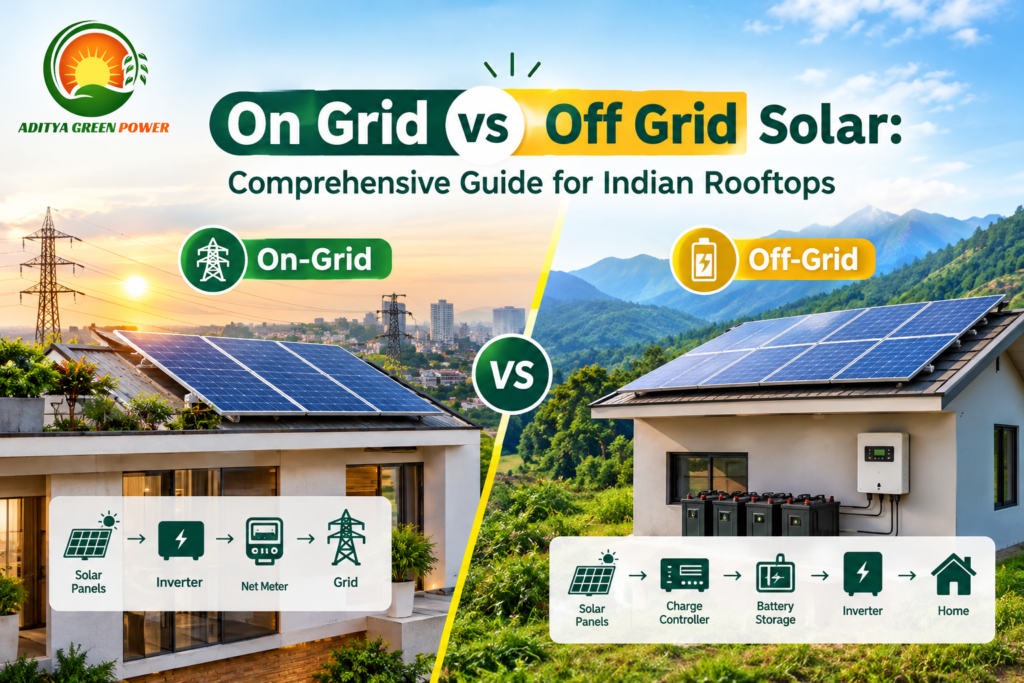
To make a well-informed choice suited to Indian conditions, it is critical to examine the engineering principles behind each framework. In particular, the core comparison of on grid vs off grid solar lies in utility grid integration versus independent battery energy storage.
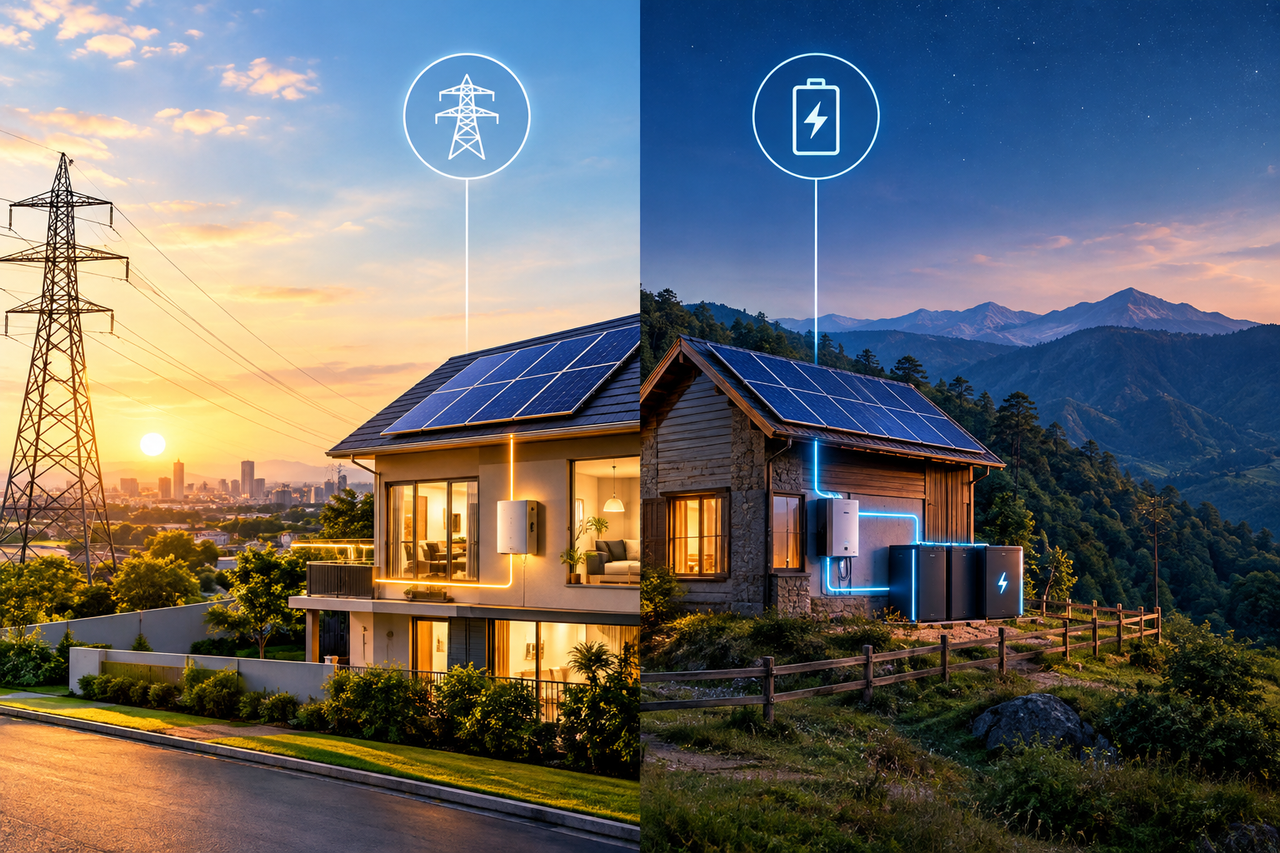
On-Grid Flow Architecture
Direct connection to public utility lines with bi-directional net metering.
Off-Grid Flow Architecture
Stand-alone setup equipped with a battery bank for complete grid independence.
1. Working Mechanics of On Grid Solar Systems
An on-grid configuration operates in direct synchronization with your local distribution company (DISCOM). During sunshine hours, rooftop solar panels generate direct current (DC), which is instantly converted to alternating current (AC) by a string or microinverter. In addition, when local production outpaces real-time consumption, the surplus is exported into the utility network through net metering.
Because this framework eliminates battery banks, setup expenses are modest. However, whenever the main grid encounters an outage, the on-grid inverter triggers an anti-islanding protocol to immediately halt power output. This safety mechanism shields line workers from dangerous back-feeding.
2. Functional Breakdown of Off Grid Solar Installations
An off-grid solar system functions completely separate from external electrical utilities. Excess electricity generated during daylight is channeled directly into lithium-ion or deep-cycle lead-acid battery banks. As a result, this system guarantees dependable power around the clock, even during extended regional power outages or stormy weather.
Furthermore, dedicated charge controllers regulate voltage spikes to safeguard battery lifespan. Although off-grid systems provide unmatched energy autonomy, the recurrent cost of periodic battery replacement must be factored into total lifecycle expenses.
On Grid vs Off Grid Solar: In-Depth Technical & Economic Comparison
Evaluating the tangible parameters of on grid vs off grid solar clarifies initial capital allocation, subsidy availability, and long-term operating costs. Below is a detailed comparison matrix tailored for property owners in India:
| Evaluation Parameter | On-Grid Solar System | Off-Grid Solar System |
|---|---|---|
| Grid Dependency | Mandatory Utility Connection | Zero Grid Connection (Autonomous) |
| Battery Storage | None required (Grid acts as battery) | Mandatory (Lithium / Tubular Lead-Acid) |
| Initial Investment | Lower Upfront Cost | High (Battery Bank Expenses) |
| Subsidy Benefits (PM Surya Ghar) | Fully Eligible for Central Subsidies | Ineligible for standard net-metering subsidies |
| Power Outage Backup | No backup (Anti-islanding shutoff) | Continuous 24/7 Power Security |
| Ongoing Maintenance | Minimal (Periodic panel cleaning) | Moderate to High (Battery checks & replacement) |
| Payback Period (ROI) | 3 to 4 Years | 6 to 8 Years |
Essential Decision Factors When Choosing On Grid vs Off Grid Solar
Selecting the best solar setup requires assessing practical variables specific to your location and power demands:
1. Government Subsidies and Net Metering Advantages
Under initiatives such as the PM Surya Ghar: Muft Bijli Yojana, Indian homeowners can claim direct central subsidies for installing verified grid-tied rooftop setups. Because these subsidies do not extend to standalone off-grid units, on-grid power offers a markedly faster payback period. For additional insights on clean energy deployment standards, review this detailed renewable energy documentation.
2. Capital Expenditure and Ongoing Battery Cycles
When analyzing on grid vs off grid solar, overall expenditure involves both upfront procurement and lifetime operating costs. Batteries incur chemical degradation through continuous charge-discharge cycles. Consequently, off-grid operators must replace their energy storage assets every 4 to 8 years, significantly raising long-term operational costs.
3. Geographic Location and Grid Stability
In metro areas and Tier-1/Tier-2 cities with reliable grid uptimes, on-grid setups provide maximum savings by minimizing costly hardware. Conversely, in remote rural communities or hilly terrains prone to persistent transmission outages, an off-grid system offers the essential resilience required for daily operations.
Which System Matches Your Needs: On Grid vs Off Grid Solar?
Select On-Grid If:
- Your local DISCOM provides dependable grid electricity with rare outages.
- Your primary goal is reducing or eliminating monthly utility bills.
- You want to secure government subsidies under the PM Surya Ghar initiative.
- You prefer a hands-off system with no battery maintenance obligations.
Select Off-Grid If:
- Your facility is located in an un-electrified or unreliable corridor.
- You operate critical equipment requiring 100% uninterrupted power.
- DISCOM connection charges or transmission drops make grid access uneconomical.
- You value complete energy independence over rapid financial payback.
Ready to Solarize Your Property with Aditya Green Power?
Whether you need a high-yield on-grid rooftop installation with net metering or a dependable off-grid system with advanced battery storage, our engineering team manages the complete lifecycle from shadow-analysis to DISCOM commissioning.
Schedule Your Site Assessment at Aditya Green PowerFrequently Asked Questions About On Grid vs Off Grid Solar
Can an on-grid solar plant operate during grid power cuts?
No. On-grid inverters include mandatory anti-islanding safety switches that stop power flow during grid failures to protect utility workers. If you need backup alongside net metering, consider a hybrid solar inverter system.
Can I convert an on-grid system to an off-grid system later?
Yes, you can adapt your setup by replacing the grid-tied inverter with a hybrid or off-grid model and integrating an appropriately sized battery bank. However, designing the layout correctly at the outset avoids redundant hardware expenses.
How much rooftop area is required for a 3 kW solar plant in India?
A typical 3 kW residential rooftop array requires approximately 250 to 300 square feet of shadow-free roof area when using high-efficiency mono-PERC or bifacial solar panels.