
Solar Company in Mussoorie: Rooftop Solar Solutions for Mountain Living
Mussoorie’s sunny slopes can help homes and shops cut power costs with the right solar setup. Choosing a trusted solar company in Mussoorie makes it easier to assess your roof, select suitable panels, and plan safe installation. This guide covers system costs, local weather needs, government support, and key points to check before hiring an installer.
Why Mussoorie Homes Need a Specialised Solar Engineering Strategy
Living in the “Queen of the Hills” comes with undeniable scenic beauty, but it also brings steep electricity tariffs, heavy winter heating requirements, and erratic mountain weather. Consequently, installing rooftop solar here is entirely different from setting up an array in plains cities like Delhi or Lucknow. Therefore, property owners must look beyond standard flat-pack installations and choose an approach built specifically for high-altitude microclimates.
Mountain Microclimates Demand Custom Structural Engineering from Your Solar Company in Mussoorie
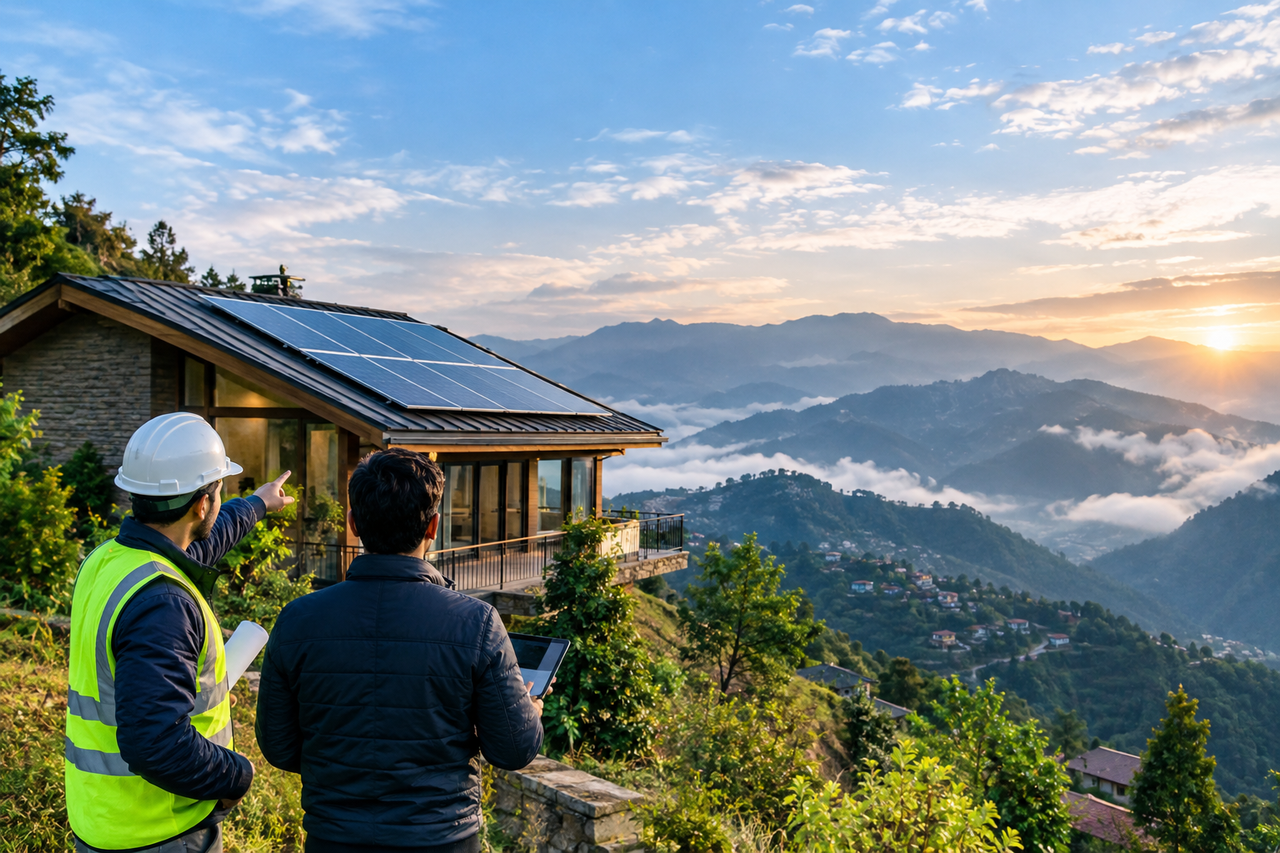 Engineered rooftop solar panel mounting on high-pitch mountain slopes in Uttarakhand.
Standard rooftop setups often fail when exposed to the varied topography of Garhwal hill stations. Specifically, mountain properties present unique architectural and environmental conditions that require careful consideration:
- Sloped Roofs and Spatial Constraints: Most residential properties in Landour, Barlowganj, and along the Mall Road feature steep colonial-style tin, slate, or metal-truss roofs. Consequently, standard ballast-mounted frames are unsuitable; installers must engineer custom-angled, wind-rated rafter clamps to anchor modules securely.
- Severe Weather Fluctuations: While Mussoorie enjoys intense UV radiation on clear afternoons, heavy cloud cover during monsoon seasons and freeze-thaw cycles in deep winter demand high-efficiency tier-1 mono-PERC or TOPCon bifacial modules with low temperature coefficients.
- Wind Uplift and Moisture Damage: High-velocity mountain gusts can rip poorly anchored panels off ridge lines. Moreover, high humidity and morning mist can trigger Potential Induced Degradation (PID) and corrosion in cheap electrical terminals.
- Topographical Shading and Complex Cable Routing: Hillside terracing often creates long physical distances between the roof arrays, the inverter room, and the main distribution panel. Because of this, installers must carefully size cable gauges to prevent unacceptable direct-current voltage drops over extended runs. For more verified local project details and direct office mapping, you can check this local resource map.
“A mountain solar system must be designed around roof angle, shade, snow, and battery needs—not only panel capacity.”
— Senior Site Engineer, Solar Projects Division
On average, a standard 1 kW rooftop array in Uttarakhand’s hill districts can generate roughly 1,200 to 1,500 kWh annually under unobstructed solar exposure. However, because local deodar trees and hillside ridges can shave hours off peak production times, an expert on-site shading audit remains vital before commissioning.
How to Choose the Best Solar Company in Mussoorie
Selecting the right partner requires separating genuine EPC (Engineering, Procurement, and Construction) companies from mere equipment brokers who lack local field experience. A dependable company oversees every single milestone through a tested structural workflow:
Site Feasibility & Structural Audit
Detailed shadow mapping & mountain roof load analysis[cite: 2]
System Design & Load Engineering
Custom mountain-grade inverter & tier-1 panel sizing[cite: 2]
UPCL DISCOM Approvals & Net Metering
Complete regulatory paperwork & central subsidy tracking[cite: 2]
Tier-1 Installation & Safety Bonding
Wind-resistant brackets, dual SPDs & chemical grounding[cite: 2]
Commissioning & Lifetime Maintenance
Bi-directional sync, monitoring setup & ongoing support[cite: 2]
Local Footprint and Technical Verification
First, verify that your prospective installer has an active project history across the foothills and ridge communities, including Dehradun, Mussoorie, Dhanaulti, and Hathipaon. Furthermore, ensure their field technicians understand how high elevations impact equipment efficiency.
Always ask for verified proof of:
- Turnkey grid-tied and hybrid installations on high-pitch metal roofs.
- DISCOM (Uttarakhand Power Corporation Limited) net-metering approvals.
- Dual-stage lightning arrestors and chemical earthing systems suited to rocky terrain.
- An established regional service team that can arrive quickly during winter emergency outages.
Complete Turnkey Responsibility
Secondly, avoid vendors who only deliver pallets of panels to your driveway and expect you to navigate the local electricity division yourself. A professional solar company in Mussoorie must handle the full life cycle of the deployment:
| Deliverable Scope[cite: 3] | Full–Service EPC[cite: 3] | Low–Cost Component Vendor[cite: 3] |
|---|---|---|
| Site Structural Survey[cite: 3] | Included (3D shadow mapping)[cite: 3] | Excluded (Homeowner assumes risk)[cite: 3] |
| DISCOM / Net Metering[cite: 3] | Handled completely by firm[cite: 3] | Homeowner must self-file with UPCL[cite: 3] |
| Central Subsidy Processing[cite: 3] | Filed via National Solar Portal[cite: 3] | Basic invoice provided only[cite: 3] |
| System Commissioning[cite: 3] | Full string & safety testing[cite: 3] | Basic electrical plug-in[cite: 3] |
| Post–Install Support[cite: 3] | Documented SLAs & monitoring[cite: 3] | Phone-only vendor support[cite: 3] |
Detailed Quote Evaluation
Furthermore, ensure your formal project estimate details every component line by line:
- Module brand, wattage, and temperature ratings.
- Inverter specifications (pure sine wave, MPPT tracking channels, IP65 weather rating).
- Hot-dip galvanized or anodized aluminum mounting frames designed for >150 km/h wind ratings.
- Dedicated surge protection devices (SPDs), DC/AC isolator switches, and copper-bonded chemical earthing pits.
System Architectures: Finding the Right Match for Hill Properties
Every home, boutique resort, and homestay has unique operational patterns. Consequently, choosing the correct configuration prevents unnecessary capital expenses while securing uninterrupted power through every season.
1. On-Grid Solar Systems (Grid-Tied with Net Metering)
On-grid solar connects directly to the state grid via a bidirectional net meter. During peak daylight hours, your system supplies your household needs, and any surplus electricity is automatically exported to UPCL to earn bill credits.
- Ideal Application: Year-round residents with stable grid availability who want to reduce steep seasonal utility bills.
- Operational Profile: Highly economical, requiring zero maintenance costs associated with chemical storage batteries.
- Energy Yield Projection: A 3 kW on-grid array typically produces between 3,600 and 4,500 units (kWh) per year under clear mountain exposure, which covers the daytime baseload of most modern households.
Note: On-grid systems automatically shut down during grid outages to prevent back-feeding into lines where utility technicians may be working.
2. Hybrid Solar with Advanced Energy Storage
Because severe storms and tree-fall incidents can interrupt hill power lines, hybrid systems combine the financial savings of net-metered solar with battery backup.
- Target Properties: Homestays, guest houses, clinics, cafe operations, and residences requiring 24/7 power for heating and connectivity.
- Storage Options:
- Lithium Iron Phosphate (LiFePO4): Excellent lifespan (3,500–6,000 cycles), compact footprint, zero maintenance, and stable performance in lower winter temperatures.
- Tubular Lead-Acid: Lower initial cost, but requires dedicated ventilated space, distilled-water maintenance, and has a shorter operational lifespan (900–1,200 cycles).
- Sample Emergency Backup Calculation: Running essential emergency loads (LED lighting, high-speed Wi-Fi router, communications, heating controls, CCTV, and refrigerator) generally consumes about 4 to 6 kWh across an overnight outage. Therefore, a properly configured 5 to 10 kWh lithium bank provides comfortable protection without oversized generation equipment.
3. Off-Grid Solar for Remote Ridges and Farmsteads
For isolated cottages along mountain tracts where extending the UPCL high-tension grid is cost-prohibitive, fully autonomous off-grid arrays provide clean independence. These setups pair larger solar arrays and extensive battery reserves with integrated backup generators to cover extended monsoonal rains and heavy winter storms.
Technical Standards for Mountain Solar Installations
A solar deployment in mountain terrain is only as durable as its structural and electrical protections. Shortcuts here can lead to premature system failure or hazardous roof conditions.
Precision Site Audits and Shadow Mapping
Never sign a contract without an extensive on-site structural and shadow analysis. Hill landscapes feature dramatic sun angle variations between mid-summer and mid-winter. In addition, tall pines and neighboring roof gables can cast long shadows across panels. If your roof experiences multiple shade lines, a qualified solar company in Mussoorie will deploy string microinverters or DC power optimizers. This prevents a single shadowed cell from dragging down the electrical yield of your entire panel row.
Electrical and Lightning Safety Protocols
Due to their elevated positions, Mussoorie ridges experience frequent thunderstorms and electrostatic discharges. Robust electrical defenses are therefore essential:
- Surge Protection Devices (SPDs): Dedicated Type-II DC and AC surge arrestors absorb transient spikes caused by nearby lightning strikes.
- Chemical Earth Pits: Mountain rock is naturally poor at conducting electricity. Installers must use specialized chemical earthing compounds (like bentonite or carbon backfill) around copper-bonded electrodes to keep soil resistance below 5 Ohms.
- Weatherproof Enclosures: All junction boxes, disconnect switches, and wiring conduit must carry at least an IP65 ingress rating to stop rainwater seepage, condensation, and mountain rodents from damaging cables.
Costs, Subsidies, and Investment Payback in Mussoorie
Installing solar power is an investment that yields clean electricity and cuts monthly operational expenses for 25+ years.
Realistic Cost Estimates and Planning Guidelines
Final project pricing depends heavily on roof accessibility, structural reinforcement, total cable length, and chosen battery storage capacity:
- 2 kW Residential System: Well suited for small households with modest daytime electricity consumption.
- 3 kW to 5 kW Rooftop System: The optimal range for standard hill residences, multi-story villas, and small homestays.
- Hybrid Systems (with LiFePO4 Storage): Higher upfront capital outlay due to specialized hybrid inverters and lithium storage batteries, but provides long-term energy independence.
Financial Support Under PM Surya Ghar: Muft Bijli Yojana
Homeowners can significantly reduce their net capital expenditure through the national rooftop solar framework. Under current central operational guidelines:
- First 2 kW Capacity: ₹30,000 per kW (₹60,000 total)
- Additional 1 kW Capacity: ₹18,000
- Maximum Central Subsidy: Capped at ₹78,000 for residential systems of 3 kW and above
To secure these subsidies, systems must be installed using domestic content compliant (DCR) solar modules, procured through an empanelled vendor, and officially commissioned with a UPCL bi-directional net meter.
Solar Payback Period Formula
Example: Mussoorie me ek standard 3 kW on-grid setup lagbhag 3,600–4,200 units per year generate karta hai, jisse saalana ₹20,000–₹30,000+ ki direct electricity savings hoti hai aur system ka cost 4 se 6 saal me recover ho jata hai.
What to Ask Before Hiring an Installer
Before committing funds or signing a contract, run through this practical vetting checklist with your prospective partner:
Take the Next Step with Mussoorie’s Trusted Solar Experts
Switching to clean rooftop power reduces steep mountain utility bills, cuts out noisy generator runs, and guarantees reliable energy during harsh winter storms. Partnering with ADITYA GREEN POWER ensures your system is custom-engineered for sloped roofs, heavy snow loads, and smooth UPCL net-metering approval.