

How to Choose the Right Solar Company in Rishikesh for Lower Power Bills
Finding the right solar company in Rishikesh is the most effective step homeowners and business managers can take to eliminate soaring power expenses. In Rishikesh, local residents face rising electricity tariffs, unpredictable summer outages, and high cooling loads from heavy tourist seasons. In addition, Uttarakhand receives strong, abundant sunlight across most months of the year. According to data from the Ministry of New and Renewable Energy (MNRE), India receives roughly 4 to 7 kWh of solar energy per square metre daily. Consequently, installing a rooftop system provides dependable clean energy for private residences, hotels, ashrams, cafes, and commercial shops.
Therefore, selecting an experienced partner guarantees long-term energy independence. This complete guide will help you find a trusted solar company in Rishikesh, compare system capacities, understand subsidies, review equipment safety, and avoid hidden costs.
“Rooftop engineering in foothill belts requires strict attention to structural stability. Because mountain gust winds travel down the Ganga basin and monsoons bring intense downpours, a rooftop system must feature hot-dipped galvanized framing, chemical anchoring, and precise tilt angles to avoid structural failure.”
Services Offered by a Solar Company in Rishikesh
When you partner with a knowledgeable solar company in Rishikesh, you receive access to customized engineering options rather than generic, off-the-shelf equipment.
First, your provider will evaluate your property to match the right system architecture:
- Grid-Connected (On-Grid) Solar Systems: These systems connect directly to the public utility grid through a bidirectional net meter. They represent the most economical choice for urban residences and busy retail shops.
- Hybrid Solar Systems: These installations combine solar panels with dedicated battery banks and smart inverters. As a result, properties maintain continuous power during blackouts while still enjoying utility net-metering credits.
- Off-Grid Solar Systems: Remote farms, forest retreats, and secluded campsites around Rishikesh rely on autonomous off-grid arrays paired with heavy-duty battery storage.
- Solar Water Heaters: Installing commercial evacuated tube collector (ETC) systems drastically reduces hot water heating expenses for busy hotels, yoga schools, and homestays.
- Commercial Solar Lighting and Water Pumps: These systems provide clean energy for perimeter illumination, municipal parks, and agricultural fields.
| System Type | Best Application | Battery Storage | Grid Interaction |
|---|---|---|---|
| On-Grid | Urban homes, shops, offices | No | Full net-metering export |
| Hybrid | Ashrams, boutique hotels, hill homes | Yes (Lithium / Lead-acid) | Balanced grid export and emergency backup |
| Off-Grid | Remote campsites, eco-farms | Yes (High-capacity bank) | Autonomous off-grid operation |
| Solar Water Heater | Hotels, homestays, wellness centres | Hot water storage tank | Direct thermal load offset |
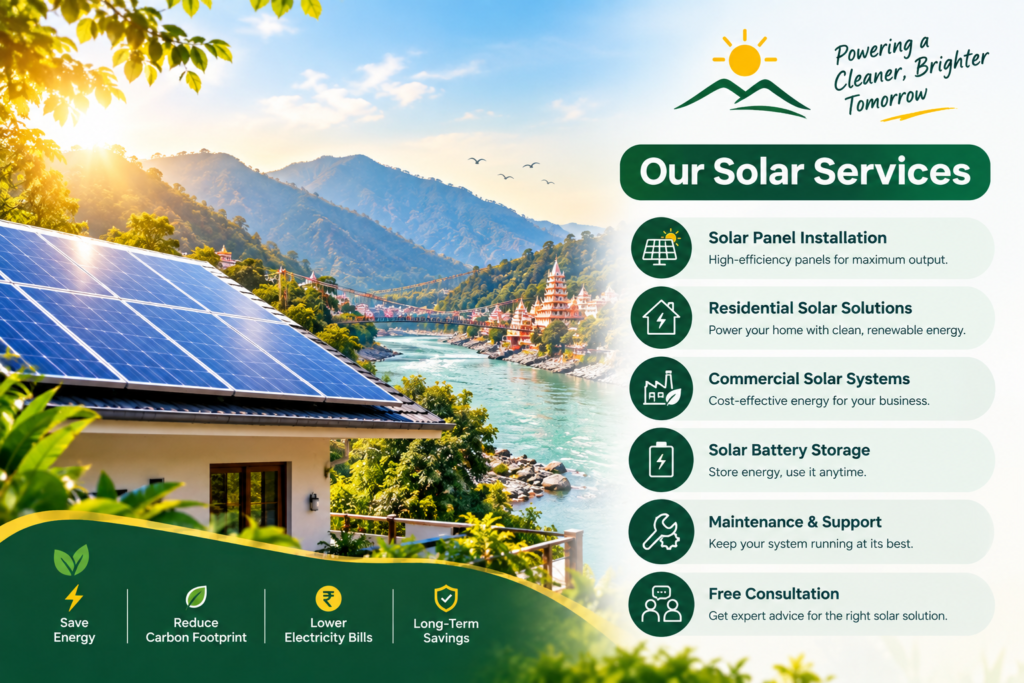
Match Your Rooftop System Size With a Solar Company in Rishikesh
Proper system sizing prevents unnecessary equipment expenditure while ensuring your generation offsets your monthly bills. A qualified solar company in Rishikesh will calculate your capacity based on historical consumption:
- 1 kW Systems: Designed for compact 1 BHK homes or low-consumption properties using 90 to 120 units monthly.
- 2 kW to 3 kW Systems: Perfect for standard 2 to 3 BHK homes running lights, ceiling fans, refrigerators, washing machines, and one air conditioner.
- 5 kW to 10 kW Systems: Ideal for large hillside villas, commercial offices, cafes, and guesthouses running multiple air conditioning units concurrently.
- Commercial Setups (10 kW+): Custom engineered for hotels, ashrams, and yoga centres with high morning and daytime machinery requirements.
Furthermore, several practical factors determine your final plant size. These include your monthly unit consumption, available terrace space, hill and tree shading, and daytime usage patterns. As a general planning rule, always collect your previous 12 months of UPCL power bills before requesting a project estimate.
Installation Standards Expected From a Solar Company in Rishikesh
Installing rooftop solar in a mountain-valley climate demands proven field experience. An established solar company in Rishikesh must demonstrate clear technical capabilities:
- Roof Compatibility: Seamless anchoring on flat concrete slabs, corrugated industrial tin sheds, and pitched rooftops.
- Monsoon Protection: Professional flashing, water runoff drainage, and certified chemical anchoring that prevent terrace water leakage.
- Wind Load Resistance: Rugged mounting structures designed to withstand strong valley drafts without bending.
- Safe Earthing: Separate copper or chemical grounding pits for AC distribution, DC arrays, and lightning protection.
- Paperwork Management: Complete handling of UPCL feasibility clearance, site inspections, and net-metering commissioning.
Moreover, always ask to inspect photos and addresses of completed client projects in Rishikesh, Haridwar, and Dehradun.
Solar Costs and Subsidies Explained by a Solar Company in Rishikesh
Transparent pricing protects your investment from surprise charges. When requesting a proposal, make sure your solar company in Rishikesh provides a clear, itemized breakdown:
- High-efficiency solar PV modules.
- Grid-tied or hybrid string inverter.
- Hot-dipped galvanized mounting structure.
- UV-resistant DC cabling and armored AC wiring.
- AC/DC distribution boxes fitted with surge protection devices (SPDs).
- Complete earthing rods and lightning arresters.
- Freight, physical labour, and utility net-metering liaison fees.
Avoid contractors who provide single-line quotes mentioning only the panel cost, because essential mounting and safety components add significantly to the overall budget.
| System Capacity | Estimated Gross Cost | PM Surya Ghar Subsidy | Estimated Net Investment |
|---|---|---|---|
| 1 kW On-Grid | ₹65,000 – ₹75,000 | ₹30,000 | ₹35,000 – ₹45,000 |
| 2 kW On-Grid | ₹1,25,000 – ₹1,45,000 | ₹60,000 | ₹65,000 – ₹85,000 |
| 3 kW On-Grid | ₹1,80,000 – ₹2,10,000 | ₹78,000 | ₹1,02,000 – ₹1,32,000 |
| 5 kW On-Grid | ₹2,90,000 – ₹3,40,000 | ₹78,000 (Capped) | ₹2,12,000 – ₹2,62,000 |
(Note: These figures serve as general estimates. Always confirm current September 2026 pricing and local rates directly with Aditya Green Power.)
Under the central government’s PM Surya Ghar: Muft Bijli Yojana, eligible homeowners receive a direct benefit transfer subsidy of ₹30,000 for 1 kW systems, ₹60,000 for 2 kW systems, and up to ₹78,000 for systems rated at 3 kW or higher. However, subsidy approvals require installing through an MNRE-empanelled vendor registered on the national portal.
Payback Period Calculation Formula
For instance, a standard 3 kW system in Rishikesh generates roughly 3,600 to 4,500 units annually. If your average electricity cost is ₹6.50 per unit, you save approximately ₹23,400 to ₹29,250 every year. Consequently, a residential system usually pays for itself within 4 to 5 years, delivering free electricity for the remainder of its 25-year service life.
Equipment Quality Evaluated by a Solar Company in Rishikesh
Selecting high-quality equipment is critical for uninterrupted system performance. A trusted solar company in Rishikesh will recommend modern monocrystalline PERC or TOPCon modules because their superior efficiency delivers maximum wattage within limited terrace space.
In addition, your inverter must match your site conditions:
- String Inverters: Most effective for clear, wide rooftops free from complex obstructions.
- Microinverters: Ideal for rooftops where nearby buildings, water tanks, or trees cast localized shadows during the day.
- Hybrid Inverters: Required when integrating battery storage for backup during grid failures.
“During intense monsoon electrical storms, voltage surges and transient lightning spikes travel rapidly through utility lines. Installing dual surge protection devices alongside independent, chemically treated earthing pits is mandatory to protect your household appliances.”
— Er. Sumit Joshi, Licensed Electrical Consultant (Interviewed: August 28, 2026)
Furthermore, ensure your installation contract includes distinct warranty policies:
- PV Module Product Warranty: 10 to 12 years against manufacturing defects.
- PV Module Linear Performance Warranty: 25 to 30 years ensuring at least 80% generation efficiency.
- Inverter Warranty: 5 to 10 years covering electronic component failures.
- Workmanship Warranty: 2 to 5 years covering structural anchors, cable joints, and roof sealing.
Real Client Projects Handled by a Solar Company in Rishikesh
Reviewing field data demonstrates how rooftop solar performs in Rishikesh’s unique foothill environment.
Case Study 1: Residential 3 kW Array in Tapovan
- Property: Three-story private residence with an open RCC roof.
- System: 3.3 kWp on-grid array utilizing Monocrystalline half-cut modules.
- Previous Bill: Averaged ₹3,800 monthly during summer peak loads.
- Yearly Generation: Produced 4,120 clean units across the first operating year.
- Financial Impact: Lowered monthly electricity bills to basic utility connection charges (approx. ₹300).
- Service Audit: Withstood two heavy monsoon seasons with zero structural shifting or terrace leaks.
Case Study 2: Commercial 12 kW Installation in Muni Ki Reti
- Property: Boutique yoga retreat and kitchen.
- System: 12 kWp grid-connected array with cloud-based remote monitoring.
- Previous Bill: Commercial billing averaged ₹19,500 monthly.
- Operational Impact: Powers daytime air conditioners, water filtration systems, and office equipment.
- Financial Result: Reduced monthly commercial utility expenses by roughly 60%.
- Uptime Performance: Logged 99.7% continuous operation with negligible maintenance downtime.
(Note: These figures represent reported client outcomes. Your actual savings will depend on specific roof orientation, daytime usage, and utility rate revisions.)
Red Flags to Avoid When Hiring a Solar Company in Rishikesh
Before making an advance payment, watch out for warning signs that point to substandard contractors:
- Promising zero-rupee electricity bills without examining your past consumption data.
- Demanding complete upfront payment before delivering mounting hardware or solar modules.
- Refusing to specify exact component brands, inverter models, and cable specifications in writing.
- Expecting customers to navigate UPCL net-metering approvals without company assistance.
- Providing lightweight, painted metal structures that rust quickly in mountain moisture.
Instead, insist on a structured milestone payment schedule: pay a nominal booking deposit, release the next tranche upon verified material delivery, and hand over the balance only after plant commissioning and net-metering activation.
Maintenance Guide Provided by a Solar Company in Rishikesh
Routine upkeep keeps your rooftop solar array generating power at peak efficiency:
- Regular Panel Cleaning: Rinse panels with fresh water every two to three weeks to remove accumulated dust, leaves, and bird droppings. Never wash hot panels during mid-day heat.
- Post-Storm Inspections: Check mounting bolts, cable conduits, and grounding connections after major monsoon rainstorms.
- App-Based Inverter Monitoring: Regularly review your mobile monitoring app to spot generation dips or inverter warning codes promptly.
- Shade Management: Keep overhanging tree branches trimmed back to prevent new shadows from falling on your panels.
- Smart Appliance Scheduling: Run high-wattage equipment like washing machines, geysers, and water pumps during bright midday hours to consume solar energy directly.
Partner With the Right Solar Company in Rishikesh for Long-Term Value
Investing in clean energy lowers your overhead, provides reliable power, and supports environmental conservation across Uttarakhand. However, realizing these long-term returns depends on partnering with a dedicated local installer who ensures sound engineering, durable hardware, and responsive after-sales support.
Before finalizing your contract, ensure you have:
- Compared written, itemized proposals from at least two reputable installers.
- Confirmed on-site shadow analysis and structural stability.
- Verified that your provider is an MNRE-approved vendor for the PM Surya Ghar subsidy.
- Checked written manufacturer warranty cards for both panels and inverters.
- Inspected completed local reference projects across Rishikesh and Dehradun.
Take control of your energy costs today. Contact the local engineering experts at Aditya Green Power to book your comprehensive site survey, get an accurate savings projection, and partner with the leading solar company in Rishikesh.
Frequently Asked Questions (FAQs)
1. How much open roof space is needed for a 3 kW solar plant in Rishikesh?
A standard 3 kW system typically requires between 200 and 280 square feet of unobstructed, shadow-free roof area. If your terrace has obstacles like water tanks or parapets, your installer can build an elevated structure to keep the terrace floor open for regular use.
2. Do solar panels generate power during cloudy monsoon seasons?
Yes. Modern Monocrystalline and TOPCon modules continue generating electricity during overcast weather by capturing diffuse light. While total output drops to about 20% to 40% of standard capacity, an on-grid system seamlessly draws needed supplemental power from the UPCL grid.
3. How long does UPCL net-metering approval take?
Physical installation takes roughly 3 to 7 days. Completing UPCL feasibility documentation, plant safety checks, bidirectional net-meter installation, and grid synchronization usually takes 3 to 6 weeks, depending on DISCOM processing speeds.
4. Will my solar panels work during a utility blackout?
Standard on-grid systems shut down automatically during power cuts to protect utility linemen working on neighborhood cables. If you need continuous power during blackouts, choose a hybrid system configured with an inverter and dedicated battery bank.
5. What is the typical operational lifespan of a rooftop solar plant?
Tier-1 solar modules come with 25- to 30-year linear performance warranties and continue generating useful electricity well past three decades. Modern solar string inverters generally operate reliably for 10 to 12 years before requiring servicing or replacement.